
Short answer: Agree staffing agency responsibilities with the client in writing, one hiring step at a time. For each step, name one owner, a deadline, the minimum information to pass on, what the candidate is told, and who is told when the deadline is missed. This covers who runs each step, not who makes the final hiring decision.
If you run roles for several clients at once, see how Radius Hire works for staffing agencies.
Key takeaways
- Agree who owns each hiring step in writing, before the first candidate moves between you.
- Use the same five fields for every step: owner, time limit, minimum information, what the candidate is told, and who is told when it slips.
- Name a person, not a company or a team, and a stand-in for when they are away.
- Keep the client's own identity check as a fixed client step, and prepare it the day before.
- Start with three handoffs for one role at one site, review weekly, and measure again after 30 days.
On this page: Why do handovers between agency and client go wrong? · Is owning a step the same as deciding who to hire? · How should staffing agency responsibilities and client responsibilities be divided? · What does an agency and client responsibility agreement look like? · Which steps should stay fixed in the agreement? · How do agency and client agree who owns each step? · What should happen when a deadline is missed? · How Radius helps · FAQ
Monday, mid-afternoon. An agency account manager and a client's site lead are on a call about the morning. Two new starters arrived an hour late. On Friday, the site had moved their start time.
"I told your planner on Friday," says the site lead.
"Your team leader was going to message them," says the account manager. "He has their numbers."
This scene is a composite, not a documented case.
Both are telling the truth about what they did. Neither of them owned the message.
This article shows how an agency and its client can stop that from happening: the five things to agree for each step, an example agreement you can adapt, the steps that should stay fixed, and a way to put it in place together and check after 30 days whether it works.
Why do handovers between agency and client go wrong?
Because the owner, the system and the rules change at once. When a candidate moves from the agency to the client site, Radius Hire's 2026 research paper on frontline hiring handoffs puts it like this: "the person responsible, the system and the legal duties all change at once."
Inside one company, a missed step has a manager above it. Between two companies, it can sit in the gap. Each side can point to the other, and both can be partly right.
The paper's view is that the costliest handoffs usually sit between agency and client. Its example hire, invented to show the problem, has eight handoffs. Two of them cross that line directly. The client's interviewer gets only a CV from the agency's screening call. And on the first day, the client's security desk has no name list and no time planned for the identity check.
The paper's first rule for better handoffs is "one named owner at every moment", with agency and client agreeing in writing who owns each handoff. It ends its list of fixes for the example hire with this: "None of these changes needs a particular product. Most need the agency and the client to agree who owns each handoff." We agree. The written agreement with the client is the fix. Everything else supports it.
Is owning a step the same as deciding who to hire?
No, they are two different agreements. The paper describes four things that move at every handoff: information, responsibility, decision rights and the candidate's interest. Two of them matter here:
- Responsibility: who does the next step, and by when.
- Decision rights: who can approve a start date or turn a candidate down.
This article is about responsibility. Who makes the final hiring decision, and how that person stays in charge when tools are involved, is covered in The Tool Should Never Be the One Saying No.
The paper defines an owner as "the one named person responsible for the candidate at a given moment, including when the next step is late". Three words in that definition do the work.
One. Not two people who each think the other has it, as in the opening scene.
Named. Not "the agency", "the client" or "the planning team". A person, with a stand-in for when they are away. A team cannot be told that a deadline was missed; a person can.
Late. The owner stays responsible when the step runs over. That is when ownership matters most.
How should staffing agency responsibilities and client responsibilities be divided?
Step by step, using the same five fields for every step. They come from the "fix" part of the paper's audit worksheet, where each priority handoff gets a single owner, a time limit, the minimum information to transfer, what the candidate is told, and who is told if the deadline is missed.
1. A single owner. One named person on one side. For steps where someone may be away, such as approvals, also name a stand-in. The paper's example hire stalls because a manager is on leave and nobody covers.
2. A time limit. When the step must be done. For document checks and approvals, the paper's example sets one working day per step. Set limits that fit your own process, and write them down.
3. The minimum information to pass on. What the next person needs to act without calling back. Keep it to a few fixed fields, written for the person who receives them. The same short handover note can travel with the candidate from step to step (see a recruitment handover template with eight fields).
4. What the candidate is told. At each step: what happened, who has their file and when they will hear next. Agree which side sends that message, or the candidate may hear twice, or not at all.
5. Who is told when the deadline is missed. A named person. In the paper's example, the branch manager is told. Without this, a missed deadline is noticed only when the candidate calls, or does not turn up.
The worksheet adds one more date: when to measure again. The paper suggests 30 days after the fixes go live, on the same number of candidates.
What does an agency and client responsibility agreement look like?
Here is an example for one role at one site. It follows the steps in the paper's example hire, from the screening call to the team leader. Replace every entry with what fits your own process.
| Step | Owner | Time limit | Minimum information to pass on | What the candidate is told | Who is told if missed |
|---|---|---|---|---|---|
| Screening call to client interview | Agency recruiter | Agree your own | What was checked, languages, experience, limits on availability | Who will interview them, when and where | Agency branch manager |
| Client interview to agency planner | Client interviewer | Agree your own | Outcome, which shifts the candidate can work, start date, any doubts | The result, and who calls next | Client site lead |
| Approval of the start | Client hiring manager, with a named stand-in | One working day | Complete file and a recommendation | When they will hear about the start | Agency branch manager |
| Contract and start details | Agency administrator | Agree your own | Start date, site address, start time, first shift, safety-shoe size | Where to go, when, and what to bring | Agency branch manager |
| Any change to the start details | One named person, agreed in advance | Same day as the change | The new detail, and who has told the candidate | The change, from one person only | The other side's named contact |
| First day at the client site | Agency planner sends; client site lead confirms | The day before | Name list, start time, slot for the identity check, induction slot | Where to report, who will meet them, which ID to bring | Agency planner and client site lead |
| Induction to team leader | Client induction lead | Before the first shift ends | Languages, experience, shift preferences | Who their team leader is | Client site lead |
Illustration built for this article, not client data.
Three notes on the table.
The "change" row is easy to forget. It is the step that failed in the opening scene. A start time that changes on a Friday needs one owner as much as the first message did.
Some cells say "Agree your own" on purpose. The paper's example gives a time limit for document checks and approvals, and it advises sending the first-day details the day before. The other limits depend on your volumes and your client.
The first-day row is built around a check the client does itself. The agreement covers how to prepare it: the name list, start time and a slot for the check, sent the day before, so the check takes minutes at the gate.
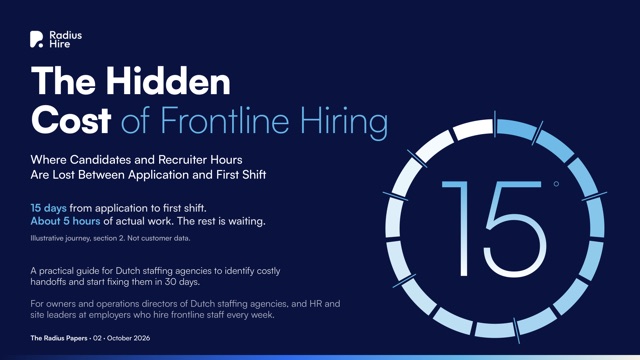
Want the research behind this article? The Radius Papers 02: The Hidden Cost of Frontline Hiring is Radius Hire's white paper for operations directors, HR managers, recruitment leaders and staffing agencies hiring frontline workers in the Netherlands. It shows where candidates and recruiter hours are lost between application and first shift. Enter your name and work email, choose English or Dutch, and Radius emails it to you: Get The Radius Papers 02.
Which steps should stay fixed in the agreement?
Checks the client must do itself stay with the client. Write them into the agreement as fixed client steps, so nobody tries to hand them over, and agree how the agency helps prepare them.
The client's own identity check. Dutch government guidance (Rijksoverheid) says a company that hires an agency worker must check the worker's original identity document itself before work starts. The same guidance says a driving licence does not count for this check, because it shows no nationality. So the agency's start message should tell the starter which document to bring. For the wider picture, see which identity, right to work and certificate checks can happen before the offer.
Other checks and records. Some steps, such as work permit checks, records of which agency supplied each worker, and who holds candidate data and copies of identity documents, depend on the rules that apply to your set-up. Agree in writing who prepares what, and check the current rules with your legal adviser. Treat who holds candidate data as a separate agreement from who owns each step. For the checks a hirer of agency workers must do itself, see the hirer's own checks, chain liability and Wav fines.
How do agency and client agree who owns each step?
Start with one role at one site, and do it together. The paper's audit is built to be run by two people: a recruitment lead and an operations lead. In agency work, it suggests one from the agency and one from the client.
1. Map the steps together. List every handoff from first contact to the end of the first week, for one role at one site. Name who does each step today. For a quick first pass, an audit of one role's hiring process in one hour is a useful start.
2. Find the gaps in ownership. Mark every step where the answer to "who owns this?" is a team, a company or two names. Those are the first candidates for the agreement.
3. Choose three to fix first. The paper recommends starting with three handoffs, not all of them. Put first any step where nobody is clearly responsible.
4. Fill in the five fields for each. Owner, time limit, minimum information, what the candidate is told, and who is told if it is missed. Write it down, and have both sides agree it.
5. Tell the people who do the work. The agreement only helps if the planner, the site lead and the security desk know what is in it.
6. Review it every week, briefly. The paper suggests the two leads meet for 15 minutes each week: which fixes are live, which deadlines were missed and what candidates said. The owner of each fix reports on it.
7. Measure again after 30 days. Measure on the same number of candidates as before. If a fix does not change the waiting time or the drop-outs, stop it and try the next handoff on the list.
The paper has no data on which steps between agency and client go wrong most often. Your own map will show you: look for steps where the owner is a team, a company or two names.
What should happen when a deadline is missed?
The named person is told, the same day. That is the whole point of the fifth field. Three habits keep it from turning into a blame exercise.
No reply does not mean "received". That is one of the paper's rules. If the client's site lead has not confirmed the name list, the agency planner treats it as not sent and follows up. The same applies in the other direction.
The stand-in acts. If the owner is away, the stand-in named in the agreement does the step. Nobody waits for the owner to come back.
Fix the step, not the person. The paper is clear that its audit scores rate handoffs, not people. Use missed deadlines the same way: to find the steps that need a better owner, a better time limit or better information.
If you plan a system that tracks how fast each person acts on a handoff, involve your works council early and check with your adviser what is needed.
How Radius helps
Radius Hire is an AI hiring platform for frontline roles, built in Amsterdam for staffing agencies and employers who hire for the work floor. It is built to source, interview and verify applicants, while a person makes every hiring decision.
For agencies, Radius is built to run every client's roles in one workspace, with permissions per team, and to keep messages, notes, the interview and contracts on one candidate record that each step reads from. Each verification check keeps its source and its date, which helps when a client asks how a placement was screened. Who owns each step is still an agreement between you and your client.
FAQ
Which hiring steps does the staffing agency own, and which does the client own?
That is for the two of you to agree, step by step. In the example agreement in this article, the agency owns the screening call handover, the contract and start details, and sending the first-day details. The client owns its interview outcome, approval of the start (with a named stand-in), its own identity check and the induction. Who carries a legal duty is a separate question to check with your legal adviser.
Who is responsible for an agency worker's first day?
Both sides are, for different tasks, so name one owner per task. In the example agreement, the agency planner sends the name list, start time and check slot the day before, and the client site lead confirms. Dutch government guidance says the client checks the worker's original ID itself before work starts. The client's induction lead then hands the starter to a team leader.
Does a written agreement change who is legally responsible?
Not necessarily, and you should not assume it does. This agreement settles who does the work at each step and who is told when it slips. Whether it changes who carries a legal duty is a separate question. Agree the steps in writing and check that question with your legal adviser.
Who should tell the candidate when the start time changes?
One named person, agreed in advance. In the opening scene, both sides thought the other would send the message, so nobody did. Put a "change to the start details" row in the agreement, with an owner, a same-day time limit and one rule: the candidate hears about the change from one person only.
Is this the same as a service level agreement?
It can sit inside one, but it does a different job. A service level agreement is usually about the service between the two companies as a whole. This agreement names people, time limits and information for each hiring step. You can keep it as a short appendix to your staffing services agreement or service level agreement, one that planners and site leads actually use.
What is the Handoff Tax?
The Handoff Tax is Radius Hire's name for the avoidable cost of passing a candidate, or information about a candidate, from one person, team, system or company to the next. Between agency and client it shows up as waiting, repeated questions, lost details and steps nobody owns. It is a practical framework, not an established academic measure.
Sources
- Radius Hire (2026). The Radius Papers 02: The Hidden Cost of Frontline Hiring. White paper. https://radiushire.com/white-papers/radius-papers-02.
- Rijksoverheid (undated). Wat moet ik als werkgever doen om te voldoen aan de identificatieplicht? Government guidance (questions and answers). https://www.rijksoverheid.nl/documenten/vraag-en-antwoord/identificatieplicht/wat-moet-ik-als-werkgever-doen-om-te-voldoen-aan-de-identificatieplicht, accessed 19 October 2026.
Written by the Radius Hire team. Sources checked on 19 October 2026.