
For information only. This article summarises Dutch rules and official guidance as of September 2026. It is not legal advice. Take your own legal advice before changing your process.
In many frontline hiring processes, the offer goes out first and the checks come later. Identity, right to work and certificates are checked by another team, just before the first shift. At the moment of decision, those requirements rest on the candidate's word.
The obvious fix is to check everything earlier. But Dutch rules set limits on what an employer may collect from applicants, and some checks are tied by law to the moment someone starts work. So the practical question is: which checks can move earlier, and which belong at the start of employment?
Short answer: In the Netherlands, an employer must verify a worker's identity with an original identity document, and check that they are allowed to work in the Netherlands, before they start work. The employer must also keep a copy of the identity document in its payroll records, made when the employee takes up employment. During the application, the Autoriteit Persoonsgegevens (AP) says employers may ask to see an original identity document, but may not ask for a copy. Certificates are different: for most frontline equipment, Dutch law requires specific expertise rather than a particular certificate, and checking relevant qualifications is part of assessing whether someone can do the job. A practical sequence is to ask a neutral eligibility question early, check job related certificates during selection, make the offer conditional on the legal checks, and complete those checks before the first shift.
Key takeaways
- Identity and right to work must be checked before someone starts work, using original documents.
- The employer must keep a copy of the employee's identity document in its payroll records, made when the employee starts.
- According to AP guidance, employers may ask applicants to show an original ID, but may not ask applicants for a copy.
- For forklifts and reach trucks, Dutch law requires specific expertise, not a specific certificate; certificates are the common proof.
- A conditional offer, with checks completed before the first shift, can close most of the gap between the decision and the evidence. Confirm your sequence with counsel.
On this page: Why the timing matters · What Dutch rules require · What can happen during the application · Certificates and qualifications · A practical sequence · Staffing agencies · Privacy and proportionality · Where technology fits · FAQ
Why the timing matters
"A New Standard for Frontline Hiring" describes a common frontline pattern: a CV, a short call, an offer, and then the checks, by a different team, in a different system, before the first shift. In its worked example for a warehouse operative, both the reach truck certificate and the right to work were only claimed at the moment of decision.
When a late check fails, the cost lands on the operation: a seat that stays empty after everyone planned around it, overtime, and another round of recruitment. The aim is not to check more. It is to have the right evidence at the right moment, within the rules.
What Dutch rules require
Identity: check the original before work starts.
FACT. The Netherlands Labour Authority states that employers may only use workers they have identified and who are allowed to work in the Netherlands, and that this verification obligation must be met before someone is allowed to work for the employer. It applies to everyone working in the company, including foreign workers, self employed workers, temporary agency workers and workers from other companies such as contractors (Nederlandse Arbeidsinspectie, 2026).
Business.gov.nl, the government's information site for businesses, adds that identity must be checked with an original, valid identity document. A driving licence or a statement from the Tax Administration is not valid proof, and a copy does not suffice.
Right to work: check before work starts.
FACT. People with Dutch nationality, and people from the EEA and Switzerland, are allowed to work in the Netherlands. Workers from outside the EEA and Switzerland must be able to prove that they are allowed to work. The Labour Authority also warns that having a citizen service number (BSN) does not automatically mean someone is allowed to work in the Netherlands (Nederlandse Arbeidsinspectie, 2026).
The copy: made at the start of employment.
FACT. Employers must keep a copy of the identity documents of their employees in their payroll records. The AP explains that this obligation comes from Article 28 of the Wet op de loonbelasting 1964, and that the copy is made at the time the employee takes up employment. The Tax Administration says the copy must be retained for at least 5 calendar years after the employment ends (Autoriteit Persoonsgegevens, 2026; Belastingdienst).
The consequence of getting it wrong.
FACT. If an employer cannot establish an employee's identity, or cannot do so in time, it must apply the anonymous rate (anoniementarief) for payroll tax, withholding 52 percent of wages for wage tax and national insurance contributions (Business.gov.nl).
What can happen during the application
FACT. According to AP guidance on job applications, an employer may not ask an applicant for a copy of their identity document, because a copy contains data that is not necessary during the application procedure, such as the passport photo and nationality. The employer may check the applicant's identity during the procedure by asking them to show the original document. Once the applicant is hired, the employer may, and must, have a copy. The same guidance says an employer may only ask for an applicant's BSN in one specific situation, linked to the Wet banenafspraak, and otherwise not until the person is hired.
INTERPRETATION. In practice, this means:
- Collecting ID copies, scans or photos from applicants is not the answer, even if a tool makes it easy.
- Asking every applicant the same neutral question about whether they are allowed to work in the Netherlands is a way to surface obvious issues early, without collecting documents or nationality data. Ask it of everyone, in the same way.
- The formal document check, and the copy, belong at the point of hire and before the first shift.
Certificates and qualifications
Certificates are where most frontline decisions can gain evidence earlier, because they are about whether someone can do the job.
FACT. Arboportaal, the Dutch government's portal on working conditions, explains that mobile work equipment such as a forklift usually requires specific expertise from the worker (Arbobesluit, Article 7.17c). A legally required proof of competence applies to operating certain equipment, such as mobile cranes and tower cranes of 10 tonne metres or more (Arbobesluit, Article 7.32).
INTERPRETATION. For forklifts and reach trucks, then, the law requires the employer to ensure the worker has the expertise, not that they hold one particular certificate. Industry sources such as evofenedex make the same point. In practice, many employers ask for a certificate because it is the most common proof of that expertise.
That has two consequences for hiring:
- A certificate is evidence, not the requirement itself. What you actually need to know is whether the person can operate the equipment safely on your site.
- Checking a relevant certificate during selection is job related. Where the issuer offers a way to verify certificates, confirming it before the decision moves the requirement from claimed to verified. Where it does not, a supervised practical check, where safe and proportionate, can show competence directly.
A practical sequence
INTERPRETATION. Based on the rules above, one workable sequence looks like this. It is our reading of the rules, not legal advice. Confirm it with counsel for your own situation.
| Stage | What can happen | What should not happen yet |
|---|---|---|
| Application and screening | Ask every candidate the same neutral question about whether they are allowed to work in the Netherlands. Ask about relevant certificates and experience. | Collecting copies, scans or photos of identity documents. Asking for the BSN (outside the Wet banenafspraak exception). Asking about health. |
| Selection | Check job related certificates where they can be verified. Demonstrate competence where safe and proportionate. If identity needs to be confirmed, view the original document without copying it. | Keeping more data than the role needs. |
| Conditional offer | Make the offer conditional on the legally required checks. | Treating the offer as final before identity and right to work are confirmed. |
| Before the first shift | Check the original identity document and right to work, make and keep the copy in the payroll records, record the BSN. | Letting someone start before the verification obligation is met. |
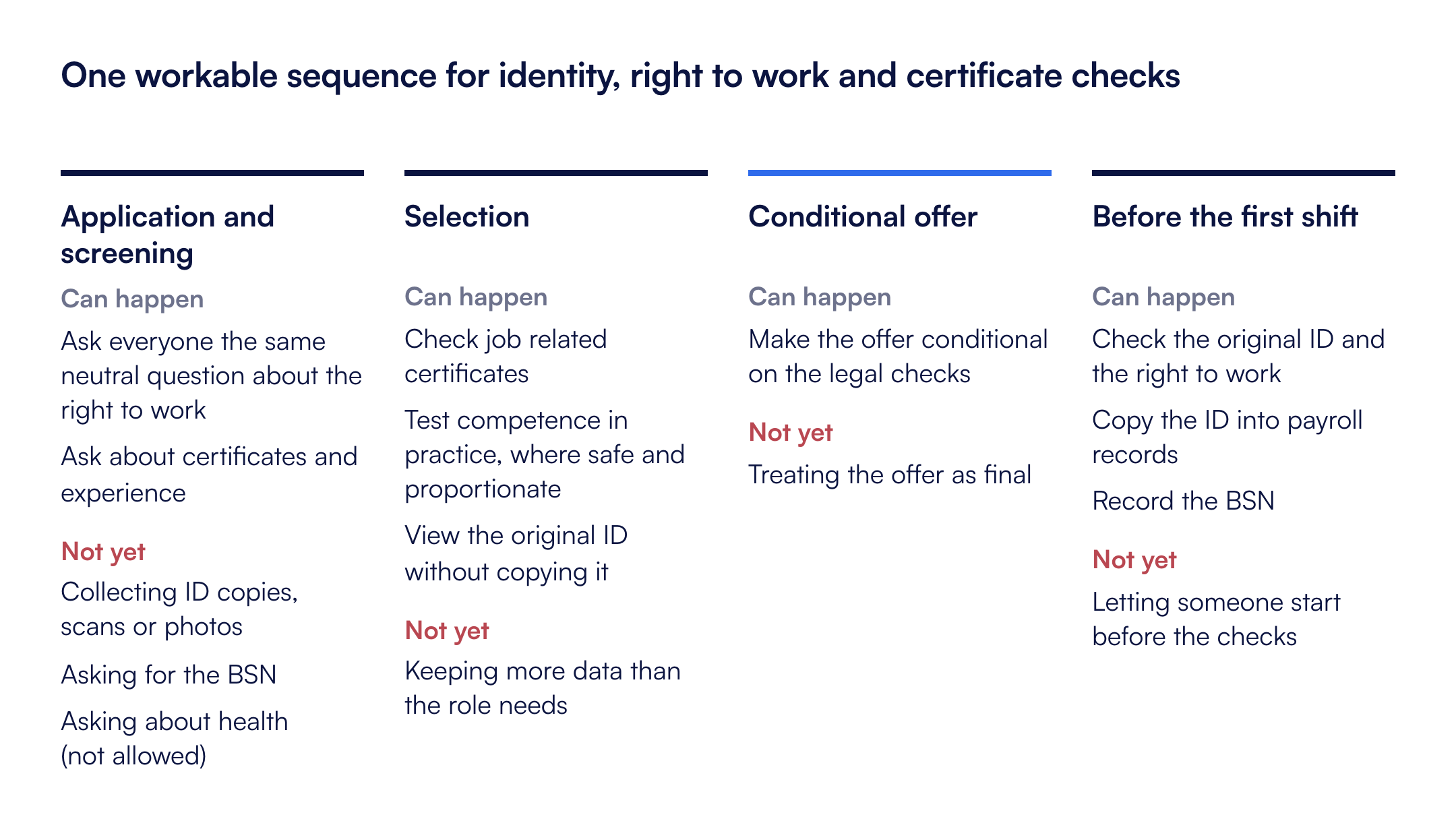
INTERPRETATION. The conditional offer is the key step. It lets you decide quickly, on the evidence you may lawfully collect during selection, while making sure the legally required checks are done before anyone starts. It also means a failed check leads to a withdrawn conditional offer, not an empty seat on day one.
Staffing agencies
For temporary agency workers, the agency is usually the employer and carries the payroll obligations, including the copy of the identity document.
FACT. The Labour Authority states that the company where agency workers actually work must also check their identity before they start. Business.gov.nl explains that a company hiring staff through contracting or secondment cannot keep a copy of the identity document, because it is not the employer, but must check the proof of identity and keep a record of it. For workers from outside the EEA and Switzerland, a copy must be kept for 5 years, and the company must check that the person is allowed to work in the Netherlands.
RECOMMENDATION. Agencies and their clients should agree in writing:
- who checks identity and right to work, and when
- which checks happen before the agency proposes a candidate, and which before the first shift
- what evidence travels with the shortlist (for example "certificate verified"), without sharing documents or data the client does not need
- how candidate data is shared and deleted, under the GDPR
Privacy and proportionality
The GDPR's principle of data minimisation applies throughout: collect only what the role needs, at the point it is needed.
FACT. The AP also notes that it is usual for an employer to delete an unsuccessful applicant's data no later than 4 weeks after the end of the application procedure, unless the applicant agrees to a longer period, for which up to 1 year is reasonable. And an employer may not ask applicants about their health or past sickness absence.
INTERPRETATION. For frontline roles, that last point matters. You can describe the physical demands of the job honestly and ask about the candidate's experience of similar work. You should not ask about their health.
Where technology fits
Technology can help by bringing certificate checks earlier, recording what was verified and when, and showing the result next to the rest of the evidence for each requirement. It cannot change what the law allows at each stage, and a person should review every check and make the decision.
Radius Passport is designed to check identity and right to work at the source and to read certificates from the document itself, with a check counting only once someone on the employer's team has reviewed it. How and when such checks run in a hiring process should follow the rules above.
FAQ
When must a Dutch employer check a new worker's identity?
Before the person starts work, using an original, valid identity document. A copy of the document must then be kept in the payroll records.
Can an employer ask a job applicant for a copy of their ID?
According to AP guidance, no. An employer may ask to see the original document during the application, but may only ask for a copy once the applicant is hired.
Who is allowed to work in the Netherlands without a permit?
Dutch nationals and people from the EEA and Switzerland. Others must be able to show that they are allowed to work in the Netherlands. A BSN alone does not prove this.
Is a forklift certificate legally required in the Netherlands?
Not as such. The law requires the worker to have specific expertise to operate the equipment. A certificate is the most common way to show it, and many employers require one.
What happens if an employer cannot establish an employee's identity?
The employer must apply the anonymous payroll tax rate, withholding 52 percent of wages.
Can checks happen before the offer?
Some can. Certificate checks and neutral eligibility questions can happen during selection. The formal identity and right to work checks, including the copy, belong at the point of hire and before the first shift. A conditional offer connects the two.
Sources
- Nederlandse Arbeidsinspectie (Netherlands Labour Authority). Action Plan for the Verification Obligation (updated May 2026) and Identity check. Labour Authority
- Business.gov.nl. Verifying employee identity. Business.gov.nl
- Belastingdienst (Tax Administration). Establish the identity of your employee; Make a copy of the ID. Belastingdienst
- Autoriteit Persoonsgegevens. Identity document at work or when applying for a benefit (July 2026). AP
- Autoriteit Persoonsgegevens. Sollicitaties (guidance on job applications). AP. Applicant ID copy guidance cited via a published reproduction of the AP page; verify against the current page.
- Arboportaal. Gebruik van arbeidsmiddelen (Arbobesluit Articles 7.17c and 7.32). Arboportaal
- evofenedex. Is een heftruckcertificaat verplicht? evofenedex
- Radius Hire (2026). A New Standard for Frontline Hiring. Sections 1.3, 2.5 and 4.4.