
We hate silos. Here is the one frontline teams feel on the floor: the certificate check that happens after the offer.
Monday, 05:30. A new reach-truck driver arrives for their first shift. The supervisor has planned the week around them.
At 07:00, someone from HR finally looks at the certificate. It covers a counterbalance forklift, not a reach truck. The site requires a reach-truck certificate, so the driver cannot operate the truck. The shift is short one person, and recruitment starts again.
This scene is a composite, not a documented case.
Nobody lied, and nobody was careless. The process simply did things in the order most frontline processes do them: decide first, check later.
Decide first, check later
Look at how a typical frontline hire happens. A candidate sends a CV. A recruiter makes a short phone call. An offer goes out. Then a different team, in a different system, checks identity, right to work and required certificates, on or just before the first shift.
The Radius Papers 01: A New Standard for Frontline Hiring describes this sequence as an archetype, not a measured average. Most people who run frontline hiring will recognise it.
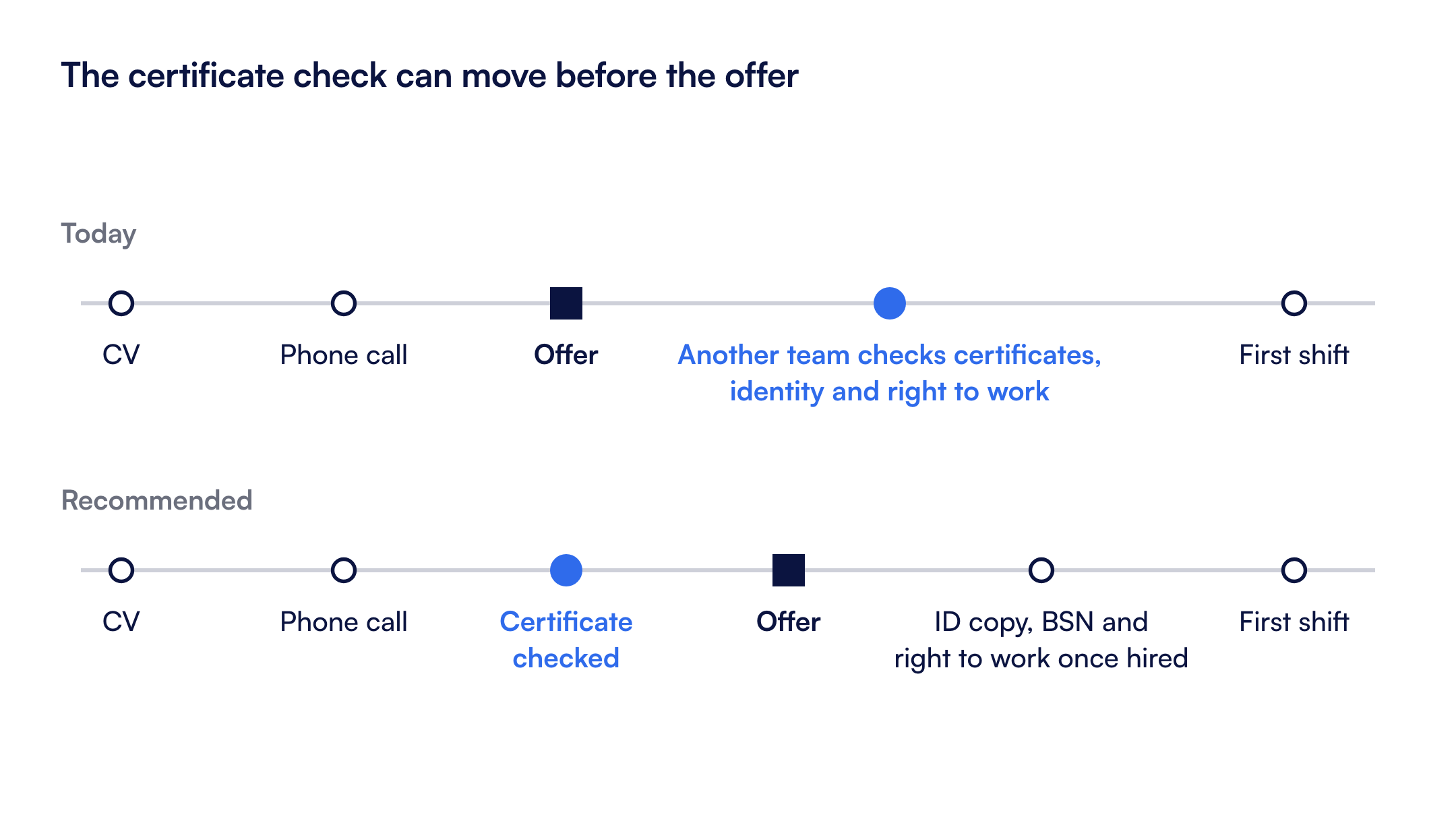
The consequence is simple. At the moment of decision, the certificate and the right to work are only claimed. The decision is made on the candidate's word. The later check either confirms it or creates an expensive problem.
That is the silo problem in one sentence. The information that could make the decision stronger exists. It just arrives in another team's inbox after the decision is already made.
The Signal Gap, a term Radius Hire introduced in The Radius Papers 01 (2026), is the distance between what a hiring decision rests on and what predicts the outcome. A certificate that nobody checks until after the offer is an everyday example.
Why do certificate checks happen after the job offer?
This order is not a failure of care. It is a reasonable response to real pressure.
The market is tight, and good candidates do not wait long. Recruiter hours are limited, and checking documents for every applicant takes time nobody has. The checks sit with other teams: compliance, payroll and site onboarding each own a piece, and nobody owns the whole. And for identity and right to work, Dutch law limits what can happen before someone is hired.
So the process optimises for speed at the front and pushes verification to the back. It works, until the check fails.
What a late failure really costs
When a check fails after the offer, the cost does not appear in the recruitment budget. It appears on the operations floor: a seat that stays empty after everyone planned around it, overtime to cover the gap, another round of recruitment for the same role. For a staffing agency, it can mean a lost placement and a harder conversation with the client.
None of this is visible when you look at time to hire alone. Time to hire looked fine. The empty seat on Monday never showed up in it.
Which checks can you move before the job offer?
Where the role needs one, the certificate. Identity and right to work follow their own rules.
Our position is simple: for the checks you can lawfully move, and where it is proportionate, verify before you decide. Only a check moves a requirement from "claimed" to "verified". A check done after the offer means the decision was made without it.
That does not mean checking everything, from everyone, as early as possible. For identity, the law sets the order, not habit. In the Netherlands, an employer may check an applicant's identity by looking at the original document, but may not copy, scan or photograph it, or ask for the citizen service number (BSN), until the person is hired (Autoriteit Persoonsgegevens).
Certificates are different. Dutch law requires operators of forklifts and reach trucks to be properly trained (Arbobesluit, Article 7.17c). A certificate from a training provider is the usual proof, and many sites and clients require a current one. It is not a state licence.
If your site or client requires a reach-truck certificate, it decides whether the person can work on day one. That makes it the check to move before the offer. Collect only what the role needs, at the point it is needed.
How do you start checking certificates before the job offer?
You do not need to redesign the process. Pick one role and move one check.
1. Find out when each check really happens. Run the one-hour audit on that role and note, for each requirement, whether it is checked before or after the offer.
2. Move the check that carries the most weight. For many warehouse roles, that is the certificate. Ask counsel first whether it can lawfully happen before the offer, and what data you may collect for it. Then tell candidates what is checked, why and when.
3. Watch what changes. Over the next hiring rounds, look at late surprises, drop-out and time to decision. If the earlier check costs you candidates, you will see it. If it saves you empty seats, you will see that too.
Why "We hate silos"
We hate two things in frontline hiring. The first is asking a CV to carry a whole hiring decision. The second is silos: sourcing, screening and verification each work on their own, and none of them sees the whole candidate at the moment the decision is made. Verification should be part of that decision, not a step after it.
The next paper in our series, Paper 02, looks at exactly this: where candidates and hours are lost between sourcing, screening, verification and the first day.
Closing thought
Saying yes before you know is sometimes necessary. Doing it by default, for a certificate you could have checked before the offer, is a choice. It is just a choice nobody ever made on purpose.
So ask your team one question: for your most common frontline role, which of the checks that matter most happen after you have already said yes?
Read The Radius Papers 01: A New Standard for Frontline Hiring for the audit method and the eight practices.