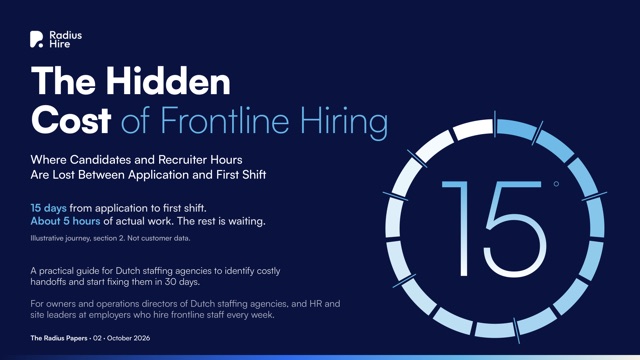
The Radius Papers 02: The Hidden Cost of Frontline Hiring
Where Candidates and Recruiter Hours Are Lost Between Application and First Shift. For owners and operations directors of Dutch staffing agencies, and HR and site leaders at employers who hire frontline staff every week.
Check your inbox in the next few minutes.
Want to talk about your own numbers? Book a demo ›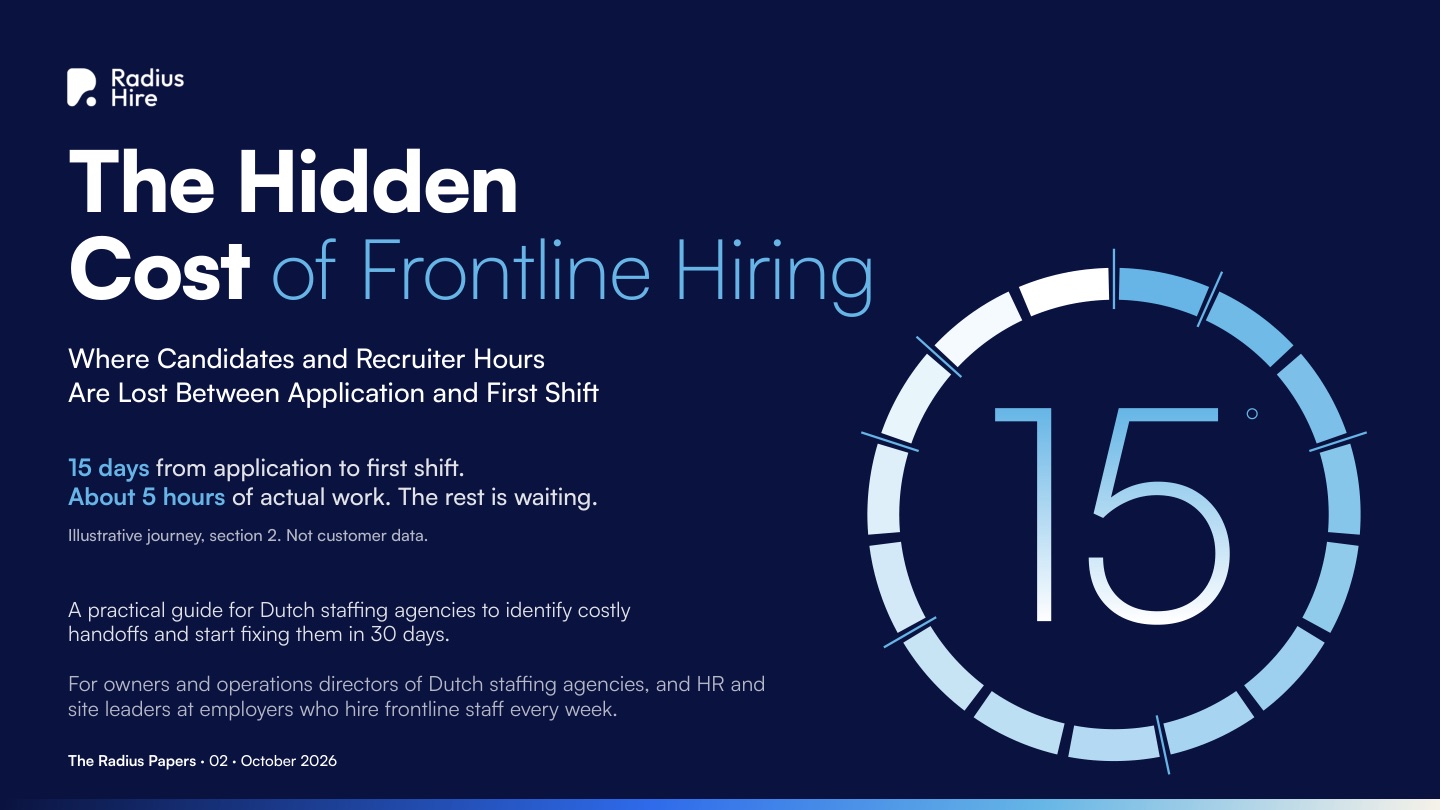
What the paper shows
Four of its charts, in its own numbers.
The 15-day hire.
15 days from application to first shift
About 5 hours of actual work. The rest is waiting.
- Work (about 5 hours in total)
- Waiting between owners (the rest of the 15 days)
Illustrative journey, section 2. Not customer data.
Along the way, Marta is passed on eight times.
- H1Job advert to agency recruiter
- H2Screening call to client interview
- H3Interview to planner
- H4Planner to administrator
- H5Administrator to hiring manager
- H6Approval to contract
- H7Agency to client site on day one
- H8Induction to team leader
The work isn't slow. The gaps are.
The figures are invented.
What it costs.
Total: €6,140 a month × 12 = €73,680 a year for one role at one site.
Illustrative example. All figures are assumptions. The model shows where to look, not what you will save.
The Handoff Tax has five parts.
- TimeWaiting for the next person to act
- EffortDoing the same work twice
- InformationDetails lost or changed along the way
- CandidateWhat the candidate goes through
- ControlNobody clearly responsible
Fewer handoffs is not automatically better.
Better handoffs usually are.
The short version
15 days from application to first shift. About 5 hours of actual work. The rest is waiting. We call this the Handoff Tax. It is the waiting, repeated work, lost details and lost candidates that pile up each time a candidate passes to the next person, team, system or company. Illustrative journey, not customer data.
What's inside
- The 15-day hire
- Your reports measure stages. The losses sit between them.
- The Handoff Tax has five parts
- What it costs: €73,680 a year at one illustrative site
- Find your Handoff Tax in two weeks
- Six rules for better handoffs
- The handoffs the law requires
- Six questions to ask any hiring tool
- How Radius Hire closes the gaps
- Your 30-day plan
Keep reading
Frequently asked questions
The Handoff Tax, in short.
The Handoff Tax is the waiting, repeated work, lost details and lost candidates that pile up each time a candidate passes to the next person, team, system or company. In the paper’s illustrative journey a hire takes 15 days from application to first shift, with about 5 hours of actual work. It has five parts: time, effort, information, candidate and control.
No. It is an illustrative example in which all figures are assumptions: €6,140 a month for one role at one site, from repeated work, late starts and avoidable drop-outs. The model shows where to look, not what you will save. Run it with your own figures.
The paper sets out a two-week method to map your own handoffs, followed by six rules for better handoffs and a 30-day plan to start fixing the costliest ones. It also lists six questions to ask any hiring tool.
Owners and operations directors of Dutch staffing agencies, and HR and site leaders at employers who hire frontline staff every week.