
Short answer: A hiring handoff is any moment a candidate, or information about a candidate, passes from one person, team, system or company to another. Recruiter to planner and agency to client site are two examples in the recruitment process. Four things move at each one: information, responsibility, decision rights and the candidate's interest. Any of them can drop between steps.
If you want to see what one shared record per candidate looks like, the Radius ATS page shows one pipeline from applied to signed, per role, site and client.
Key takeaways
- A hiring handoff is any moment a candidate or their details change hands.
- Each handoff moves information, responsibility, decision rights and the candidate's interest. Information is the easiest to see.
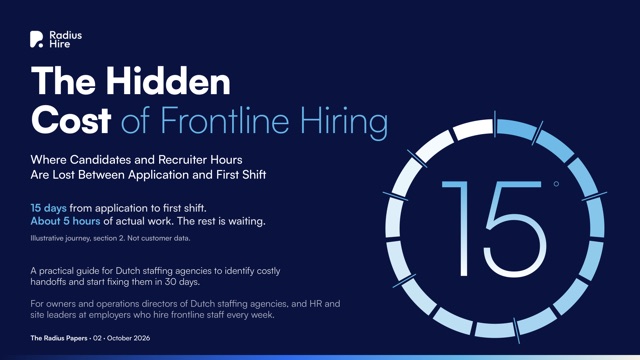
- In an illustrative 15-day hire, the actual work came to about five hours. The rest was waiting.
- Keep handoffs that exist for a legal check, a second pair of eyes or a real decision, and make them fast.
- Stage reports such as time to hire do not show handoff losses. Timing the waits between steps does.
On this page: What is a hiring handoff? · What moves at a hiring handoff? · What types of hiring handoff are there? · What does a hiring handoff cost? · Where does a frontline hire lose time between hiring steps? · Are all hiring handoffs a cost? · Why don't hiring reports show handoff losses? · What are the risks of a fragmented hiring process? · How strong is the evidence? · How do you find the handoffs in your own recruitment process? · How Radius helps · FAQ
On a Monday, Marta applies for an order-picker job through a job site. She lives in Limburg. A staffing agency is filling the job for a distribution centre that runs three shifts a day.
Her screening call is the next day. The client interview follows on day 3. Then the file slows down. Her availability is confirmed on day 7, when the planner works through the weekly list. Her documents are complete on day 10, after a second request. The manager approves on day 12, back from leave. She signs on day 13 and starts on day 15.
Add up the actual work on her file and it comes to about five hours. The rest of those two weeks is waiting.
This scene is a composite, not a documented case.
Nobody in Marta's story was careless. The time went into the gaps between the people doing the steps. For agencies and employers hiring frontline staff every week, those gaps are where candidates, recruiter hours and start dates get lost. This page shows what drops at each handoff, and which handoffs to keep or fix.
What is a hiring handoff?
It is any moment a candidate or their details change hands. The full definition, from Radius Hire's 2026 research paper on frontline hiring handoffs, is: any moment a candidate, or information about a candidate, is passed from one person, team, system or company to another.
In frontline hiring, think of the agency recruiter (in Dutch, the intercedent) passing a candidate to the planner. Or the agency passing a new starter to the client site. A job site sending an application into your applicant tracking system (ATS) is a handoff too. So is the moment you go back to the candidate to ask for a document again.
Handoffs are not a mistake in themselves. Any set of hiring process steps with more than one person in it will have them. The useful question is what gets lost when the work changes hands.
What moves at a hiring handoff?
Four things move at once, and each one can drop.
- Information. Facts like availability, documents, pay and shift pattern, and the details behind them: doubts, preferences and what was promised.
- Responsibility. Who does the next step, and by when.
- Decision rights. Who can approve a start date or turn a candidate down.
- The candidate's interest. The trust and willingness to start that the last conversation built. The next person either keeps it or loses it.
Information is the easiest of the four to see, because it sits in a note or a field. The other three are easier to lose without anyone noticing. A file can arrive complete and still sit untouched, because nobody agreed who acts next or who may say yes.
Two habits help. A short handover note that travels with the candidate keeps the details from the screening call alive for the planner (see this recruitment handover template with eight fields). And telling candidates what happens next, at every step, keeps their interest alive during the wait.
What types of hiring handoff are there?
The paper sorts handoffs into five types. Each one fails in its own way.
| Type | Example | What can go wrong |
|---|---|---|
| Person to person | Recruiter to planner | A long phone call becomes a short note |
| Team to team | Recruitment to payroll or compliance | Work waits in a queue with no deadline |
| System to system | Job board to ATS, ATS to payroll | Fields that do not match; information typed in twice |
| Company to company | Agency to client site | Owner, system and required checks all change at once |
| Back to the candidate | Candidate asked to resend a document | Repetition that makes you look disorganised |
The company-to-company handoff deserves a separate note. When a candidate moves from the agency to the client site, the person responsible, the system and the checks each side must do all change at the same moment. That is why the agency and the client need to agree, step by step, who owns each hiring step.
The last type is the one candidates notice directly. When teams and systems do not pass information on, the candidate ends up carrying it for them.
What does a hiring handoff cost?
The cost that matters is the avoidable part. That means the waiting, repeated work and lost details that would not be there if the handoff had an owner, a deadline and a clear note of what to pass on.
Radius Hire calls this avoidable cost the Handoff Tax: the avoidable cost of passing a candidate, or information about a candidate, from one person, team, system or company to the next. It is a practical framework, not a validated scientific measure.
The paper describes the avoidable cost in five parts. They overlap, and they are not weighted by evidence.
| Part | What it means | How to spot it | Example |
|---|---|---|---|
| Time | Waiting for the next person to act | Time between passing the candidate on and the next person doing something | Documents uploaded on Friday, first checked on Tuesday |
| Effort | Doing the same work twice | Data typed in, questions asked or checks done more than once | The recruiter records availability, then the planner asks again |
| Information | Details lost or changed along the way | Compare what the sender knew with what the receiver acted on | The contract arrives without the site address or start time |
| Candidate | What the candidate goes through | Days without contact; times asked to repeat something | The candidate has to call to ask where to go on day one |
| Control | Nobody clearly responsible | No named owner, deadline, escalation route or record | Approval waits because the manager is on leave and nobody covers |
The framework has limits. The paper says it is not a substitute for outcome measures such as retention at 90 days. It describes where a process loses time and information. It does not predict how a hire will turn out. If you want a euro figure, the paper also sets out a cost model that uses your own figures and labels every input as an assumption.
Where does a frontline hire lose time between hiring steps?
Mostly in waits after handoffs that had no deadline.
Illustration built for the paper, not client data.
Marta was passed on eight times between her application and the end of her first week.
| # | Handoff | What should be passed on | What goes wrong | Part of the cost | What Marta experiences |
|---|---|---|---|---|---|
| H1 | Job advert to agency recruiter | Shift pattern, site, pay, travel options | Old advert still says day shifts are available | Information | Wrong expectations from the start |
| H2 | Screening call to client interview | What was checked, language, experience, limits on availability | The interviewer only gets a CV | Effort, Information | Tells her story again |
| H3 | Interview to planner | Which shifts she can work, start date, any doubts | Note says "flexible"; the planner works through a weekly list | Time, Information | Days without news |
| H4 | Planner to administrator | ID, bank and tax details | ID photo unreadable; second request sent at the weekend | Time, Effort, Candidate | Asked twice, unsure why |
| H5 | Administrator to hiring manager | Complete file and a recommendation | Manager on leave; nobody covering | Control, Time | Start date slips |
| H6 | Approval to contract | Start date, site address, safety-shoe size, first shift | Contract sent without site address or start time | Information | Calls to ask where to go |
| H7 | Agency to client site on day one | Name list, start time, ID check, safety induction | Security desk has no list; no time planned for the ID check | Information (a check that must stay) | Waits at the gate |
| H8 | Induction to team leader | Language, experience, shift preferences | Team leader only knows her name | Information, Control | Unsure what is expected in week one |
Three things stand out.
The long waits followed handoffs without a deadline. The planner's weekly list (H3, day 3 to day 7) and a manager on leave with nobody covering (H5, day 10 to day 12) each added days. Between them, they account for six of the 15 days in this example.
Several losses were information, not time. An old advert (H1), a contract without an address (H6) and a team leader who knows only a name (H8) cost Marta little waiting. They cost her a clear picture of the job.
One handoff has to stay. Dutch government guidance (Rijksoverheid) says a company that hires an agency worker must check the worker's original identity document itself before work starts. The same guidance says a driving licence does not count for this check, so tell the starter which document to bring. H7 is not waste. The loss there was not the check. It was that nobody prepared the security desk for it or planned time for it. For which identity and right to work checks can happen earlier in the process, see Verifying Frontline Candidates: Which Identity, Right to Work and Certificate Checks Can Happen Before the Offer?
Are all hiring handoffs a cost?
No, some handoffs exist for a good reason. The reason can be a legal check, a second pair of eyes, or a real decision. The paper calls these structural handoffs. Keep them, and make them fast and clear. Decide which checks to keep before you redesign anything else.
An avoidable handoff exists only because of how work, systems or teams happen to be set up. Merge it, remove it, or give it an owner and a deadline. But first check what is really causing the delay. A long wait at one handoff can start somewhere else, such as one person carrying too many open files.
Merging steps has a price too. If one recruiter screens, checks and approves the same candidate, there is no handoff, and no second pair of eyes.
Why don't hiring reports show handoff losses?
Because reports measure stages, and handoffs sit between them. Time to hire and cost per hire add up total days and total cost. They do not separate the hours someone spent working on a candidate from the days the candidate spent waiting for the next person.
To see those waits, record two times for each handoff: when the candidate or file was passed on, and when the next person first acted on it. The gap is the waiting time. A related blind spot is what the team knew when it decided, which Your Hiring Is Not Too Fast. Your Evidence Arrives Too Late. covers.
What are the risks of a fragmented hiring process?
A fragmented process can lose in five ways. From the outside, these losses can look like ordinary hiring process bottlenecks.
- Candidates. Some drop out while they wait for the next step.
- Recruiter hours. Repeated questions, resent documents and chased approvals take time from the next candidate.
- Shifts. Late starts and no-shows leave positions empty, and that cost lands in payroll and operations, not in the recruitment budget.
- Control of personal data. Every inbox or spreadsheet that holds a copy of an ID document is one more place to protect, and one more copy to delete later. Agree in writing who holds which candidate data between agency and client, and check the current rules with your privacy adviser.
- A clear record. When nobody owns a step, it becomes harder to show who checked what, and when.
How strong is the evidence?
The evidence points one way, but much of it is indirect. It comes from research on delay and drop-out in hiring, and from handover research in other fields. A widely cited handover study comes from hospital care. Across nine hospitals, a structured handover programme for doctors in training, called I-PASS, was associated with a 23% fall in medical errors, with no significant change in how long spoken handovers took (Starmer et al., 2014, New England Journal of Medicine). The programme was more than a template: it also included communication training, training for the supervising doctors and a campaign to keep the habit going. A hospital ward is not a hiring desk, and the size of that effect does not carry over. What carries over is the principle: a handover with a fixed structure loses less than an improvised one.
No published study found for the paper measures handoff losses directly in Dutch or European frontline hiring. Candidates also leave for reasons no agency controls, such as a better offer or a change at home. So the paper does not ask you to accept a number. It asks you to measure your own process.
How do you find the handoffs in your own recruitment process?
Map one role at one site, using records you already have. A recruitment lead and an operations lead list every handoff, time the waits on 20 to 30 real candidate journeys and mark which handoffs must stay. The paper calls this the Handoff Audit. It takes about two weeks of part-time work and needs no new software. How to Map Your Recruitment Process in Two Weeks walks through it step by step.
To start smaller, How to Audit Your Hiring Process for One Role in One Hour shows how a recruiter and a supervisor can check, for one role, what your process actually knew about each requirement when it decided. If the changes you then plan touch recruitment rules or how staff work is tracked, check early with your adviser whether the works council (ondernemingsraad) needs to be involved.
How Radius helps
Radius Hire is an AI hiring platform for frontline roles, built in Amsterdam for staffing agencies and employers who hire for the work floor. It is built to source, interview and verify applicants, while a person makes every hiring decision.
For handoffs, the Radius ATS is built to keep one pipeline from applied to signed, per role, site and client. WhatsApp and email threads, notes and the interview sit on one candidate record, so the next person can see what was already asked. For agencies, every client's roles can run in one workspace, with permissions per team. Deciding who owns each handoff stays with you.
FAQ
Is a hiring handoff the same as a recruitment handover?
Yes, the two terms describe the same moment. "Handover" is more common in British English and "handoff" in American English. Both mean a candidate, or information about a candidate, passing from one person, team, system or company to the next. This page uses "handoff", as the research paper does.
Is a hiring handoff only the recruiter passing a shortlist to the hiring manager?
No, that is only one example. Some teams use the word only for that moment. The wider meaning covers every pass between people, teams, systems and companies, including going back to the candidate for a document. Recruiter to hiring manager is one example of the person-to-person type.
How many handoffs does a frontline hire have?
There is no reliable average, so count your own. In the paper's illustrative example, one order picker was passed on eight times between application and her first week. Your number will depend on how many people, systems and companies your process uses.
Which steps in the recruitment process involve a handoff?
Any step where the candidate or their file moves to a new person, team, system or company. In the paper's illustrative example, there are eight: job advert to agency recruiter, screening call to client interview, interview to planner, planner to administrator, administrator to hiring manager, approval to contract, agency to client site on day one, and induction to team leader. Your own list will depend on how many people and systems your process uses.
Who should own a hiring handoff?
One named person, at every moment. That person can answer "Where is this candidate, and what happens next?" and is the one who is told when a deadline is missed. In agency work, the agency and the client should agree in writing who owns each handoff, because in the paper's view the costliest gaps often sit between the two.
Do you need new software to reduce handoff losses?
No. In Radius Hire's view, the first fix is an agreement, not a tool, because much of the Handoff Tax comes from steps with no owner and no deadline. Agreeing owners, deadlines and a short handover note is a management decision. Software helps most once those are settled.
Sources
- Radius Hire (2026). The Radius Papers 02: The Hidden Cost of Frontline Hiring. White paper. https://radiushire.com/white-papers/radius-papers-02.
- Rijksoverheid, Government of the Netherlands (n.d.). Wat moet ik als werkgever doen om te voldoen aan de identificatieplicht? Official guidance (question and answer). https://www.rijksoverheid.nl/documenten/vraag-en-antwoord/identificatieplicht/wat-moet-ik-als-werkgever-doen-om-te-voldoen-aan-de-identificatieplicht, accessed 19 October 2026.
- Starmer, A. J., Spector, N. D., Srivastava, R., et al. (2014). Changes in medical errors after implementation of a handoff program. New England Journal of Medicine, 371(19), 1803 to 1812. Journal article. https://doi.org/10.1056/NEJMsa1405556, accessed 19 October 2026.
Written by the Radius Hire team. Sources checked on 19 October 2026.