
Short answer: To hand over a candidate without losing information, use a recruitment handover template, also called a candidate handover template: a short note with the same eight fields every time, written for the person who receives it. One named person owns the next step, with a deadline, and the receiver confirms they have the note and says what is missing.
A note works best when it has one place to live: see how the Radius ATS keeps messages, notes and the interview on one candidate record.
Key takeaways
- Write the handover note for the person who receives it, with the same fields in the same order every time.
- One named person owns each next step, with a deadline and someone to tell when it slips.
- The receiver confirms the note and says what is missing. No reply does not mean "received".
- A template alone is not enough. In the I-PASS hospital study, the format came with training and observation (Starmer and colleagues, 2014).
- Keep health information, copies of ID documents and loose labels out of the note.
On this page: What is a candidate handover? · Why do details get lost when a candidate changes hands? · What can hiring learn from hospital handovers? · What are the six rules for a better handover? · What should a recruitment handover template include? · How does one note work at different handovers? · Why should the receiver confirm the handover? · Is a handover template enough on its own? · What should stay out of a handover note? · How Radius helps · FAQ
At the end of a night shift on a children's ward, one doctor hands her patients to the doctor starting the day. She knows which child needs watching, which test result is still due and what she told a worried parent. In a few minutes, all of that has to move into someone else's head.
On a Friday afternoon at a staffing agency, a recruiter passes five new starters to the colleague who sends out contracts. One note reads "OK to start Monday". On the call, the recruiter had promised the candidate a start on the 14th, after her notice period ends. The contract and start message go out for Monday. On Monday the client's shift is one person short, and the candidate wonders whether the agency listened at all.
Both scenes are composites, not documented cases.
Nobody lost that promise on purpose. It just never made it into the note.
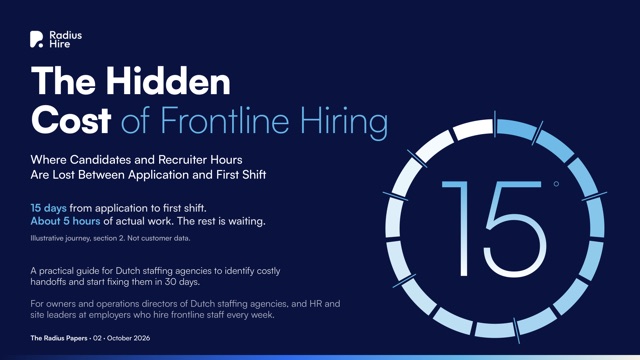
Both scenes describe the same moment: work changes hands, and the details have to survive the move. Radius Hire's 2026 research paper on frontline hiring handoffs looks at where frontline candidates and recruiter hours are lost between hiring steps. This article takes one part of it: a handover note, and the habits around it, that let the next person act without calling back.
What is a candidate handover?
It is the moment one person passes a candidate to the next. The paper defines the wider idea, a hiring handoff, like this: "A handoff is any moment a candidate, or information about a candidate, is passed from one person, team, system or company to another."
This article is about the person-to-person version. A recruiter (at a Dutch staffing agency, the intercedent) passes a candidate to a planner or to the client's interviewer. A planner passes the file to an administrator. An agency passes a starter to the client site.
The paper sums up the typical failure in one line: a long phone call becomes a short note.
Why do details get lost when a candidate changes hands?
Because the note is written for the sender, not the receiver.
The sender heard the whole conversation. To them, "OK to start Monday" is a complete thought, because they remember the context around it. The receiver reads four words. They act on what is written, not on what the sender meant.
The paper describes the problem in two parts. Details get lost when a handoff relies on free text written for the sender, not defined content written for the receiver. And they get lost when nobody checks that the receiver understood.
The paper's example hire shows what this looks like in practice. It is an invented journey, built to show the problem, not customer data. In it:
- the client's interviewer receives only a CV, so the candidate tells her story again
- the contract goes out without the site address or start time, so she calls to ask where to go
- the team leader on her first day knows only her name
None of these is a big mistake. Each is a detail that the sender knew and the receiver needed. The paper suggests a simple test for finding them: compare what the sender knew with what the receiver acted on.
What can hiring learn from hospital handovers?
That a fixed handover format works best with training and follow-up.
At nine teaching hospitals in the United States and Canada, junior children's doctors (paediatric residents) adopted a handover programme called I-PASS. Across 10,740 admissions, medical errors fell by 23 percent and spoken handovers took no longer (Starmer and colleagues, 2014).
In numbers, medical errors went from 24.5 to 18.8 per 100 admissions. Preventable adverse events, meaning harm to patients that could have been avoided, fell by 30 percent, from 4.7 to 3.3 per 100 admissions. The study compared results before and after the programme started; it was not a randomised trial, and it was not a recruitment study.
The programme had several parts: a standard structure for spoken and written handovers, training in handovers and communication, senior doctors observing real handovers, and a campaign to keep the practice going.
Two lessons carry over to hiring. The stakes and error rates of a hospital do not.
First, define the content in advance. The hospitals agreed what every handover must contain. The receiver could then rely on finding the same things in the same place every time.
Second, the form was never the whole programme. Training, observation and follow-up were part of it. A template on its own is not what was tested.
Our view: as the paper puts it, "The habit matters more than the template." Introduce the note with training and a few real checks, or expect it to fade.
What are the six rules for a better handover?
One owner, a fixed note, a confirmation, deadlines, updates and asking once.
The paper sets out six rules. The note and the receiver's confirmation get their own sections below.
1. One named owner at every moment. At any point, one person can answer: "Where is this candidate, and what happens next?" Between an agency and its client, the paper says both sides should agree in writing who owns each handoff (see how agency and client agree who owns each hiring step).
2. A short, fixed handover note. A few standard fields, so the next person can act without calling back. Written for the person receiving it, not the person sending it.
3. The receiver confirms. The next person confirms they have it and says what is missing. No reply does not mean "received".
4. A deadline and someone to tell. Every handoff has a deadline, and when it is missed, a named person is told. In its example hire, the paper suggests one working day for document checks and approvals, a named stand-in for approvals, and telling the branch manager when a deadline is missed.
5. Keep the candidate informed. At every step, tell the candidate what happened, who has their file and when they will hear next.
6. Ask once, reuse with care. Information the candidate already gave is reused, not asked for again. Reuse it only for the purpose it was given, and check with your privacy adviser where you are unsure.
What should a recruitment handover template include?
Eight fixed fields, always in the same order and written for the receiver, make a simple handover checklist.
The paper lists the core content: what was checked, what the candidate can and cannot do, what was promised, and the start details. The template below adds the fields the six rules call for: the owner and deadline, the candidate's doubts, what the candidate has been told, and the receiver's confirmation.
| # | Field | What to write | Why the receiver needs it |
|---|---|---|---|
| 1 | Owner and next step | Who has the candidate now, what happens next, and by when | So nobody wonders whose move it is (rules 1 and 4) |
| 2 | What was checked | What has been confirmed, and how: on the call, or from a document. Also what has not been checked yet | So the next person neither repeats a check nor assumes one was done |
| 3 | What the candidate can and cannot do | Shifts they can work; the start date they can make; languages they can work in; the experience they described | So the next person can act without calling back |
| 4 | What was promised | Anything the candidate was told they would get: a shift, a start date, a contact | So a promise is not broken by someone who never knew about it |
| 5 | Doubts and open points | Anything the candidate hesitated over or asked to come back to, in their words | So the detail that matters later is not lost now |
| 6 | Start details (once known) | Start date, site address, start time, first shift, safety-shoe size | So the candidate does not have to call to ask where to go |
| 7 | What the candidate has been told | Who has their file now, and when they will hear next | So the next person does not contradict it |
| 8 | Receiver confirms | The date the receiver got the note, and anything missing | So "sent" and "received" are not confused (rule 3) |
Illustration built for this article, not client data.
They are a starting point; adjust them to your process.
Copy-ready version. Paste the eight fields into your ATS note field or a shared document, and fill them in for every candidate you pass on:
1. Owner and next step: [who has the candidate now] / [next step] / [by when]
2. What was checked: [confirmed on the call] / [confirmed from a document] / [not checked yet]
3. What the candidate can and cannot do: [shifts] / [start date they can make] / [languages] / [experience, in their words]
4. What was promised: [shift, start date or contact the candidate was told they would get]
5. Doubts and open points: [in the candidate's words]
6. Start details (once known): [start date] / [site address] / [start time] / [first shift] / [safety-shoe size]
7. What the candidate has been told: [who has their file now] / [when they will hear next]
8. Receiver confirms: [date received] / [anything missing]
Four habits make the template work in practice.
Write it while the conversation is fresh. The person who passes the candidate on writes the note, during or straight after the conversation, for the person receiving it.
Write in the candidate's words where it matters. "Worked two years as an order picker with a hand scanner" is more useful than "has warehouse experience". "Wants to start on the 14th, after her notice period" is more useful than "OK to start". In the opening scene, field 4 alone would have saved the Monday.
Leave a field empty rather than guess. An empty field tells the receiver something is not known yet. A guess looks like a fact.
Start from a good record. A handover note is only as good as what the step before it recorded. If your screening step uses structured interviews that record each answer, not only the outcome, fields 2 and 3 almost fill themselves.
When the note records shifts or the physical side of the job, keep one rule in mind. Ask about the job's demands and the candidate's experience of similar work, never about health or medical conditions.
Want the research behind this template? The Radius Papers 02: The Hidden Cost of Frontline Hiring is Radius Hire's white paper for operations directors, HR managers, recruitment leaders and staffing agencies hiring frontline workers in the Netherlands. It shows where candidates and recruiter hours are lost between application and first shift. Enter your name and work email, choose English or Dutch, and Radius emails it to you: Get The Radius Papers 02.
How does one note work at different handovers?
The same note travels with the candidate; each receiver reads their part. In its example hire, the paper suggests one short note for three handovers.
Screening call to client interview. The interviewer needs what was checked, the languages the candidate works in, the experience they described and any limits on their availability. Without it, the candidate tells their story again.
Approval to contract. The contract and start message need the start date, the site address, the safety-shoe size and the first shift. Without them, the candidate calls to ask where to go.
Induction to team leader. The team leader needs the candidate's languages, experience and shift preferences. Without them, the team leader knows only a name, and the new starter is unsure what is expected in week one.
Two handovers have a job of their own. Between the screening call and the planner, capture availability shift by shift during the call itself, so the planner gets an answer rather than a task. On the first day, the client site does its own identity check, so the name list, start time and induction slot go over the day before.
Why should the receiver confirm the handover?
Because sending a note is not the same as it arriving. The paper's third rule is direct: no reply does not mean "received".
A confirmation does two jobs. It tells the sender the candidate has moved on. And it gives the receiver one moment to say what is missing, while the sender still remembers the call.
Keep it simple. The receiver replies "received", plus anything missing, within the deadline for that step.
Our suggestion, not a rule from the paper: agree that the sender stays responsible until the receiver confirms. That way, a candidate is never in nobody's hands.
Is a handover template enough on its own?
No: it needs training, real checks and someone to keep it going. The hospital programme included all three, and a template on its own was not what was tested. Three steps help a hiring team build the habit.
Train the senders. Show recruiters and planners the difference between a note written for themselves and one written for the receiver. Use real notes from your own process, with names removed.
Look at real handovers. The paper's audit suggests 15 minutes with each person involved: the recruiter, planner, administrator and site lead. Ask what they receive, what is usually missing and what they have to chase. Then compare a handful of notes with what the receiver actually did. For a quicker first look, an audit of one role's hiring process in one hour helps you spot information that was collected but never used.
Keep it going. Agree who checks that the note is still in use a month later. Habits can fade quietly; a short regular check helps you notice.
The paper offers no recruitment trial of a handover note, so measure your own: time a sample of real candidate journeys for one role at one site, before and after you introduce the note. How to Map Your Recruitment Process in Two Weeks sets out a method for this.
What should stay out of a handover note?
Health information, ID copies and labels without the words behind them.
Health or medical information. You should not ask about it, so it should never appear in a note.
Copies of identity documents. The note travels from person to person and system to system. An ID copy should not. Every extra copy is one more place where it must be protected and deleted on time. Dutch government guidance (Rijksoverheid) says a company that hires an agency worker must check the worker's original identity document itself before work starts, and may not keep a copy in its own records, except for workers from outside the EEA. For the wider checks, see which identity and right to work checks Dutch employers make, and when.
Labels without the words behind them. "Good candidate" or "seems keen" tells the receiver what the sender felt, not what the candidate said. Write what was said, and let the receiver judge.
How Radius helps
Radius Hire is an AI hiring platform for frontline roles, built in Amsterdam for staffing agencies and employers who hire for the work floor. It is built to source, interview and verify applicants, while a person makes every hiring decision.
For handovers, the Radius ATS is built to keep WhatsApp and email threads, notes, the interview, offers and contracts on one candidate record, so the next person reads what was said rather than a one-line note. The AI Interviewer is built to give every applicant a structured voice interview, with a recording, a transcript and a summary your recruiter reads, and Match reads each interview against the role's requirements. The handover habits stay with your team.
FAQ
What is a recruitment handover template?
A short, fixed note that one person fills in when they pass a candidate to the next, with the same fields in the same order every time. The template in this article has eight fields: owner and next step, what was checked, what the candidate can and cannot do, what was promised, doubts and open points, start details, what the candidate has been told, and the receiver's confirmation. It is written for the person who receives it, not the person who sends it.
How long should a candidate handover note be?
As short as the receiver can act on, usually a few lines per field. The paper asks for a few standard fields, not a form. If a field is never used at one handover, drop it there. A note that is too long gets skimmed.
Should a candidate handover be spoken or written?
Written every time, with a short call when something is unclear. The I-PASS hospital programme used a standard structure for both spoken and written handovers. In hiring, the written note is the record the next person can return to. A quick call helps with a doubt or a promise, but the note should still record it.
What happens to a candidate when the recruiter is away?
A named stand-in takes over, working from the same note. The paper's example hire stalls because a manager is on leave and nobody covers. Name a stand-in for every step where someone may be away, keep the note on the shared candidate record rather than in one person's inbox, and tell the candidate who has their file now.
Does the same template work for in-house hiring?
Yes, the fields are the same; only the people change. In a company that hires directly, the handover runs from recruiter to hiring manager, HR administration and team leader rather than to an agency planner and client site. Owner, what was checked, what was promised, doubts and start details still need to reach the next person.
What is the Handoff Tax?
The Handoff Tax is Radius Hire's name for the avoidable cost of passing a candidate, or information about a candidate, from one person, team, system or company to the next. It shows up as waiting, repeated work, lost details, a worse candidate experience and unclear responsibility. It is a practical framework, not an established academic measure.
Sources
- Radius Hire (2026). The Radius Papers 02: The Hidden Cost of Frontline Hiring. White paper. https://radiushire.com/white-papers/radius-papers-02.
- Starmer, A. J., Spector, N. D., Srivastava, R., et al., for the I-PASS Study Group (2014). Changes in medical errors after implementation of a handoff program. New England Journal of Medicine, 371(19), 1803 to 1812. Journal article. https://doi.org/10.1056/NEJMsa1405556. Abstract accessed via Europe PMC (PMID 25372088), 19 October 2026.
- Washington University School of Medicine in St. Louis (2014). Medical errors drop with improved communication during hospital shift changes. News release. https://source.washu.edu/2014/11/medical-errors-drop-with-improved-communication-during-hospital-shift-changes/, accessed 19 October 2026.
- Rijksoverheid (undated). Wat moet ik als werkgever doen om te voldoen aan de identificatieplicht? Government guidance (questions and answers). https://www.rijksoverheid.nl/documenten/vraag-en-antwoord/identificatieplicht/wat-moet-ik-als-werkgever-doen-om-te-voldoen-aan-de-identificatieplicht, accessed 19 October 2026.
Written by the Radius Hire team. Sources checked on 19 October 2026.