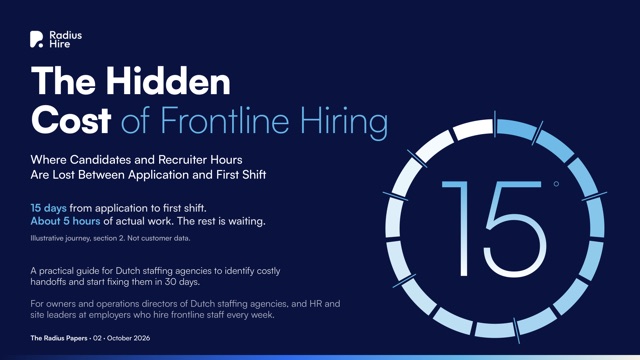

Short answer: Recruitment process mapping means listing every step and handoff a candidate passes through, then measuring where they wait and what gets lost. To do it in two weeks, take one role at one site. Time the waits on 20 to 30 real candidate journeys, score each handoff from 0 to 2, fix three and measure again.
If you only have an hour this week, start with How to Audit Your Hiring Process for One Role in One Hour, which checks what your process knew about each requirement when it decided.
Key takeaways
- Map one role at one site. A narrow scope gives you a map someone can own.
- Two people run it together: a recruitment lead and an operations lead, ideally one from the agency and one from the client.
- Time two things at every handoff: the waiting time and the touch time. Use the median and note the worst case.
- Score each handoff from 0 to 2 on five kinds of loss, then fix only three.
- Measure again 30 days after the fixes go live, on the same number of candidates.
On this page: What is recruitment process mapping? · Who should map the recruitment process? · What do you need before you start? · How do you map a recruitment process, step by step? · What does a finished hiring process map look like? · How do you choose the three handoffs to fix? · What do the scores not tell you? · What does the full cycle look like? · What should a recruitment process map template include? · How Radius helps · FAQ
It is a Tuesday afternoon. The branch manager of a staffing agency and the site manager of the distribution centre it supplies sit down with one printout: last month's applications and placements for order pickers. They have half an hour.
They do not try to fix anything. They agree on one role, one site and one period: everyone who applied for an order-picker job at this site in the last six weeks. They agree how many candidate journeys to look at, and that the list must include people who dropped out and people who never turned up.
Then the site manager asks a question nobody had thought about: "Who is going to pull the timestamps?" The meeting ends without a single fix. That is how it should end.
This scene is a composite, not a documented case.
If you run a staffing agency or hire frontline staff every week, this guide turns a vague sense that "hiring is slow" into a map of where time and candidates go, and three fixes you can measure.
What is recruitment process mapping?
Recruitment process mapping produces a hiring process map: each hiring step, its owner, and what happens between steps. This method focuses on the between: every hiring handoff, meaning any moment a candidate, or information about a candidate, is passed from one person, team, system or company to another.
The map shows where candidates wait, where work is repeated and where details get lost, and which of those you can fix. Radius Hire's 2026 research paper on frontline hiring handoffs calls this method the Handoff Audit. Some of the cost of a handoff is unavoidable. The avoidable part is what the map looks for.
Who should map the recruitment process?
Two people should run it together, one from each side of the work. One is a recruitment lead, such as the branch manager or a senior recruiter. The other is an operations lead, such as the planner or the client's site manager.
In agency work, the paper suggests that one comes from the agency and one from the client, because it expects the costliest handoffs to sit between the two. That is the paper's view, not a measured finding, and your map will show whether it holds for you.
You do not need a consultant or new software. You need the two leads, a simple spreadsheet and about two weeks of part-time work.
What do you need before you start?
Settle these six things in the first meeting.
| Item | What the paper suggests |
|---|---|
| Scope | One role, one site, one period. For example, order pickers at one distribution centre, covering everyone who applied in the last six weeks. |
| Sample | 20 to 30 candidate journeys. Include people who started, people who dropped out and no-shows. |
| Records | Stage dates in your applicant tracking system (ATS), the planner's lists, and emails and WhatsApp messages with their timestamps. Add document requests, the client's approvals, start dates, day-one attendance and any recorded reasons for dropping out. |
| People | 15 minutes with each person involved in the hire. |
| Time | About two weeks of part-time work: one week to list and time the handoffs, one week to talk to people, score and choose fixes. |
| Privacy | Reference numbers or initials in your records, not full names. Never copy ID documents into them. The audit should not create new copies of personal data. |
Why one role and one site? Because waits and owners change from site to site and role to role. A narrow scope gives you a map you can act on. A broad one gives you an average nobody owns.
How do you map a recruitment process, step by step?
Follow seven steps: four build the map, three turn it into decisions.
Step 1. Agree the scope in one short meeting
The recruitment lead and the operations lead meet once, with last month's applications and placements for the role. Choose the role, the site, the period and the number of candidates before you collect anything. Deciding the sample first stops you from picking the journeys that support what you already believe.
Step 2. List every handoff
List every handoff from the first contact to the end of the first week. Include every time you go back to the candidate, for example to ask for a document again. For each handoff, name one owner. Then agree who will pull the timestamps.
In the paper's illustrative example, one order picker passed through eight handoffs between application and her first week. Write them down in the order they happen, not the order your hiring process flowchart says they should.
Step 3. Describe each handoff
For each handoff, note who passes what to whom, in which system, and who owns it. Then note:
- how long it waits
- what is repeated
- what is missing when it arrives
- what the candidate experiences
- who is told when it goes wrong
The last question is the easiest to leave blank. If nobody is told when a handoff stalls, it can stall for days without anyone deciding to let it.
Step 4. Time the waits
For each candidate, note when each handoff was sent and when the next person first acted on it. That gap is the waiting time. Then ask the person who did the work how long it actually took: the touch time. Record both. Use the middle value (the median) for each handoff, so one extreme case does not distort the picture, and note the worst case next to it.
Step 5. Talk to the people involved
Spend fifteen minutes each with the recruiter, the planner, the administrator and the site lead. Ask three questions: what do you receive, what is usually missing, and what do you have to chase?
The paper also suggests asking two or three candidates who dropped out what happened from their side. Their answer can be the one detail no timestamp shows. Before you contact anyone, check with the person who handles privacy in your organisation that you may contact these candidates for this purpose.
Step 6. Score each handoff
Give each handoff a score of 0, 1 or 2 on each of the five kinds of loss the paper describes: Time, Effort, Information, Candidate and Control.
| Score | What it means, for each of the five kinds of loss |
|---|---|
| 0 | No real loss. Fast, complete and clearly owned. |
| 1 | Some loss. Delays of a day or more, some chasing or repetition; usually clear who owns it. |
| 2 | Regular loss. Waits of several days, routine chasing, candidates repeating themselves, or nobody clearly responsible. |
Each handoff gets a total from 0 to 10. Then mark it structural (it must stay) or avoidable, and write down why. The paper offers four reasons to choose from: the law, separation of duties, a decision point, or none. A handoff with no reason in that column is avoidable.
Step 7. Fix three, then measure again
Pick three handoffs (see the next sections). For each one, agree six things:
- one named owner
- a time limit
- the minimum information to pass on, ideally in a short handover note (see this recruitment handover template)
- what the candidate is told
- who is told when the time limit is missed
- the date you will measure again
Thirty days after the fixes go live, measure again on the same number of candidates.
What does a finished hiring process map look like?
Each row shows one handoff, its owner, its wait and what was lost. Here is part of a map for one order-picker journey, using the paper's example of a candidate who applied on day 0 and started on day 15. In your own map, each wait is the median across your 20 to 30 journeys.
Illustration built for this article from the paper's example, not client data.
| Handoff | Owner | System | Wait in this journey | What was lost | Structural or avoidable |
|---|---|---|---|---|---|
| Screening call to client interview | Agency recruiter | ATS, email | 2 days | Interviewer only got a CV; candidate repeated her story | Structural decision point; the missing note is avoidable |
| Interview to planner | Planner | Weekly planning list | 4 days | Availability noted as "flexible"; no news to the candidate | Avoidable delay (weekly list, no deadline) |
| Planner to administrator | Administrator | Email, WhatsApp | 3 days | ID photo unreadable; second request sent at the weekend | Structural check, avoidable repeat |
| Administrator to hiring manager | Hiring manager | 2 days | Manager on leave, nobody covering | Structural decision, avoidable wait |
The planner and manager rows account for six of the 11 waiting days shown. Neither fix needs new software: a deadline on the planner's list and a named stand-in for the manager.
How do you choose the three handoffs to fix?
Start with the highest totals, then apply three rules. All three come from the paper.
- Control first. Put any handoff with a Control score of 2 at the top, whatever its total. It points to a legal, data or decision risk.
- Break ties by drop-out. If two handoffs score the same, pick the one closest to the point where candidates in your sample actually dropped out.
- Match the fix to the type. Make a high-scoring structural handoff faster and clearer. Merge or remove a high-scoring avoidable one.
Three is a deliberate limit. With three fixes, each one has an owner who can report on it. With ten, you will not know which one made the difference.
What do the scores not tell you?
The scores rate handoffs, not the people who handle them. They help one team decide what to fix first. They are not a benchmark between sites or companies, a validated measure or a prediction. The paper says so directly: the 0 to 2 scale is deliberately coarse, scores depend on the judgement of the people completing them, and 20 to 30 journeys show patterns, not statistically reliable rates.
A high score is also not proof of the cause. A long wait can mean the owner is simply overloaded, which is a capacity problem rather than a handoff problem (see Frontline Hiring Does Not Have a Knowledge Problem. It Has a Capacity Problem.). Check workload before you act on a score.
If you plan to keep timing handoffs after the audit, or to change how recruitment is organised, check early with your adviser whether the works council (ondernemingsraad) needs to be involved.
What does the full cycle look like?
Two weeks of mapping, about two weeks of fixes, then a second measurement. The paper sets it out as a 30-day plan for one role at one site.
| When | What to do | Who | What you have at the end |
|---|---|---|---|
| Days 1 to 7 | Agree the scope. List every handoff, name an owner for each and pull the timestamps. | Recruitment lead and operations lead | A map of every handoff, with an owner for each |
| Days 8 to 14 | Talk to the people involved. Score each handoff and mark it structural or avoidable. Put a euro figure on the losses with your own figures (see how to price the cost of vacancy and slow hiring). | Both leads, plus 15 minutes with each person involved | Scores, a euro estimate and three priority handoffs |
| Days 15 to 30 | Fix the three priority handoffs: one owner, a deadline, a short handover note, a message to the candidate and someone to tell when it goes wrong. | The owners of the three handoffs | Three fixes in place |
| 30 days after the fixes | Measure again on the same number of candidates. Keep what worked. Choose the next three. | Both leads | A before-and-after comparison from your own data |
After that, keep it short. The two leads meet for 15 minutes each week: which fixes are live, which deadlines were missed and what candidates said. If a fix does not move the waiting time or the drop-outs at the second measurement, stop it and try the next handoff on the list.
What should a recruitment process map template include?
Keep one record per role and site, on paper or in a spreadsheet. The six parts below follow the worksheet in the paper and work as a recruitment process map template. Your team fills it in; nobody outside needs to see it.
| Part | What it holds |
|---|---|
| A. Audit details | Role and site, audit period, number of journeys, the two audit owners, date completed |
| B. Map the handoffs | For each handoff: from step, to step, people, systems, information that must transfer, one named owner |
| C. Diagnose each handoff | Waiting time (median and worst case), touch time, repeated work, missing information, candidate impact, escalation route, improvement opportunity |
| D. Score | 0 to 2 on Time, Effort, Information, Candidate and Control; total; structural or avoidable, and why |
| E. Fix three | Owner, time limit, minimum information, what the candidate is told, escalation, remeasure date |
| F. Remeasure and value | Median wait and repeated requests, before and after; estimated value in euros |
Keep measured figures, such as timestamps and counts, apart from estimates, such as hourly costs, and label which is which, so a finance director can check the comparison.
How Radius helps
Radius Hire is an AI hiring platform for frontline roles, built in Amsterdam for staffing agencies and employers who hire for the work floor. It is built to source, interview and verify applicants, while a person makes every hiring decision.
For mapping, the Radius ATS is built to report time to hire, drop-off and cost per hire per role, site and source. WhatsApp and email threads, notes and the interview sit on one candidate record, so the dates your two leads need are in one place. Choosing owners and fixes stays with your team.
FAQ
What tools do you need to map a recruitment process?
A spreadsheet and your existing records are enough. You need stage dates from your ATS, the planner's lists, and the timestamps on emails and WhatsApp messages. Process mapping software can help draw the map, but the hard part is agreeing owners and timing real waits, which no tool does for you.
How is recruitment process mapping different from a recruitment process audit?
They answer different questions. A one-hour recruitment process audit checks what your process actually knew about each requirement when it decided. A two-week map looks at what is lost between steps: what Radius Hire calls the Handoff Tax, the avoidable cost of passing a candidate or their details to the next person, team, system or company. You can run both on the same role.
Can you map several roles or sites at once?
You can, but start with one. Waits and owners change from site to site, so a combined map gives you an average nobody owns. Run the method on one role at one site, fix three handoffs, then repeat elsewhere. Do not rank sites by their scores: the 0 to 2 scale is for choosing fixes within one team, not a benchmark.
What if candidates drop out where the waits are short?
Then the handoffs are probably not the main cause. Look at pay, travel distance or the job itself, and at what candidates were told about shifts. The map is still useful: it rules out one explanation and shows you where to look next.
How do you improve a recruitment process?
Start by mapping one role at one site, then time the waits on 20 to 30 real candidate journeys. Fix only three handoffs, giving each one a named owner, a time limit, a short handover note and a message to the candidate. Measure again 30 days after the fixes go live, on the same number of candidates, and keep what moved the waiting time or the drop-outs.
Sources
- Radius Hire (2026). The Radius Papers 02: The Hidden Cost of Frontline Hiring. White paper. https://radiushire.com/white-papers/radius-papers-02.
Written by the Radius Hire team. Sources checked on 19 October 2026.