
Here is an uncomfortable fact about hiring research.
The method with the strongest average evidence for predicting job performance is the structured interview. A structured interview asks every candidate the same job-related questions and rates each answer against a standard written in advance.
Validity here is an estimated correlation between what a selection method says about candidates and their rated job performance, corrected for measurement error: 0 means no relationship, 1 a perfect one. On the revised 2022 estimates, structured interviews average 0.42, a moderate link to job performance, and the highest of the 25 methods reviewed. Unstructured interviews average 0.19. Years of job experience average 0.07 (Sackett and colleagues, 2022). These are averages from many studies, mostly outside the Netherlands, and they measure overall job performance, not retention.
Now the catch. The researchers behind the revised estimates note that, in their traditional in-person form, structured interviews are generally not a viable strategy for high-volume jobs, and that when technology takes over delivery, validity has to be checked again (Sackett and colleagues, 2022).
Read those two findings together, and the problem in frontline hiring looks different from the one most advice tries to solve.
The problem is not what people know
Much of the conversation about better hiring assumes the problem is knowledge. Write another guide, run another training, share another research summary, and recruiters will hire better.
We have no survey of what recruiters know. We do not need one. The researchers behind the evidence say the method is hard to run at volume. That points to capacity.
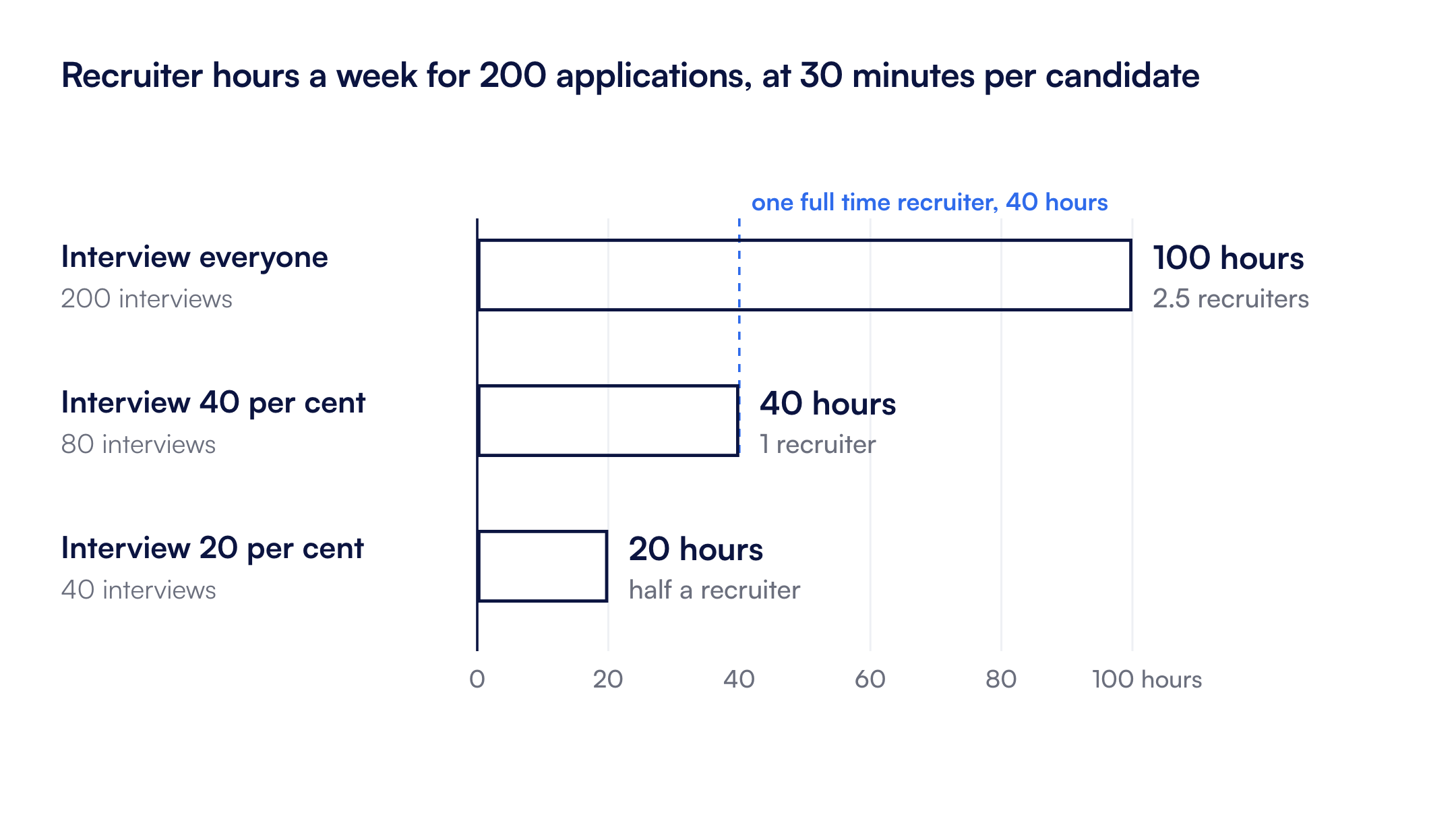
The arithmetic makes it concrete. In the worked example in The Radius Papers 01: A New Standard for Frontline Hiring (2026), 200 applications a week at 30 minutes per candidate, including rating, take 100 recruiter hours if everyone gets a structured interview, and still 20 if one in five does. Those are example inputs, not measurements. The full model is in How to Run Structured Interviews at High Volume.
Why do structured interviews break at high volume?
Because structure is a behaviour repeated hundreds of times a week, across every person who screens candidates, not a decision made once. Under volume, questions get skipped or reworded, peaks arrive before capacity does, and the rating step goes first. Time to fill is measured. Consistency is not, so it gives way first.
Structure erodes quietly. Nobody announces that they are dropping a question. A recruiter skips the shift-pattern question because the candidate "clearly" fits. Another rewords it to save time. By the end of the month, three people are running three different interviews under the same name. None of it shows up in a report.
The pressures point the other way. Time to fill is visible to everyone. An empty seat is visible to the site manager. Consistency is invisible until something goes wrong. When the week gets busy, the thing nobody measures is the first thing to give.
Volume arrives in peaks. A process designed in a quiet month has to survive the week when a new site opens or a large client order lands. That is exactly when the structure is most needed and least likely to hold.
The rating step is the first casualty. Asking the questions is the easy part. Rating every answer against a written standard, and recording it, is what makes a structured interview structured. Under pressure, "good feeling" quietly replaces the rating.
Put plainly: believing in structure does not protect it. A process designed for your best week will not hold in your worst.
Speed is not the villain
It would be easy to say "slow down". We will not.
In a tight market, fast is rational. The goal is structure that survives your real volume.
Where technology fits, and where it stops
The parts of structure that collapse under volume are the repetitive ones: asking every candidate the same questions, recording every answer, and keeping answers next to the requirement they relate to. Technology can carry some of that load. It does not remove the need for a recruiter.
And a tool that asks the questions should not become the thing that decides.
There is also an evidence reason for caution. The researchers behind the revised estimates also say evidence on newer methods, such as asynchronous video interviews and AI-based scoring, has not yet built up (Sackett and colleagues, 2023). Helping to run a structured process at volume is one thing. Claiming a tool predicts performance better is another, and nobody should make that claim without evidence.
Two moves that matter more than another training
Design for your worst week, not your best. Keep the question set short enough to survive a peak: one question per requirement that carries weight, not twenty. If it cannot be run the same way on your busiest day, it is not really your process.
Make erosion visible. Once a month, take a handful of recent screens and check them against the question set and the rating standard. Were all the questions asked? Were the answers rated, or just summarised? You will learn more from that than from any policy document.
Closing thought
A good interview is easy to describe. Doing it for the 150th candidate of the week, the same way as for the first, is the hard part.
So here is the question worth asking your team: if your interview process were checked on your busiest day of the year, how much structure would be left?
Next: How to Run Structured Interviews at High Volume, with the full workload model, a four-question example and a launch checklist.