
At 02:14 on a Sunday, a candidate for a warehouse job gets an email. Thank you for your interest. Unfortunately, we will not be moving forward with your application.
Nobody at the company has read the application. Nobody will. A system compared it with a set of criteria, scored it, and sent the message.
On Monday, the recruiter sees a tidy dashboard: 400 applications, 60 moving forward, 340 closed. It feels efficient. It is efficient.
This scene is a composite, not a documented case.
But it raises a question hiring teams need to answer more honestly than they usually do: when the system said no, who actually made the decision?
Can AI make hiring decisions in the EU?
Only within narrow limits. Under Article 22 of the GDPR, a decision about a candidate that has significant effects may not be based solely on automated processing, unless a narrow exception applies, such as necessity for entering into a contract. Even then, the candidate can ask for a person to review the decision. European data protection authorities add that any human involvement must be meaningful rather than a token gesture (WP251rev.01).
The Court of Justice of the EU has looked at a similar pattern. In 2023, in a case about credit scoring, it held that an automatically generated score can itself count as an automated decision under the GDPR, where the party using it draws strongly on that score to decide (SCHUFA, Case C-634/21). Hiring is not credit, and lawyers will debate how far the ruling reaches. The practical lesson for hiring teams: judge a process by what drives the outcome, not by what the process chart says.
AI used to recruit or select people is high-risk under Annex III of the EU AI Act. After the Digital Omnibus on AI (Regulation (EU) 2026/1744), the main high-risk duties apply from 2 December 2027. Article 14 requires providers to build high-risk systems so the people overseeing them can understand their limits, stay alert to over-reliance and override the output. Article 26(2) requires employers to give that oversight to people with the competence, training and authority to use it. What that means in practice is set out in AI in Hiring: What Technology Should Evaluate, and What People Must Decide.
Nobody sets out to hand over the decision
The pressure on frontline hiring is real. Applications arrive in waves. Recruiter hours do not grow with them. So AI tools increasingly sit between the application and the recruiter, and some of them filter, score, rank or reject.
Few teams decide to let software make hiring decisions. It happens in smaller steps.
A filter is switched on to save time. The recruiter reviews what it passes, not what it drops. The rejections go out in one click, or with no click at all.
Ranking does the same thing more quietly. The order decides who gets read, long before anyone decides who gets hired.
At no point did anyone choose to hand over the decision. But in practice, the ordering and the filter made it.
In staffing, the question gets harder
Now add a staffing agency.
The client sends an order for 30 order pickers. The agency screens several hundred applicants with a tool that filters and scores them, and sends the client a shortlist. The client picks from the shortlist. Candidates who were filtered out never reach anyone's desk.
So who said no to them? The agency's recruiter, who never saw them? The client, who only saw the shortlist? The vendor, whose system applied the criteria? If each party can point to another, the honest answer is that nobody did.
Before any law comes into it, that is a responsibility gap, and it is exactly the kind frontline volume creates.
What does meaningful human oversight in hiring look like?
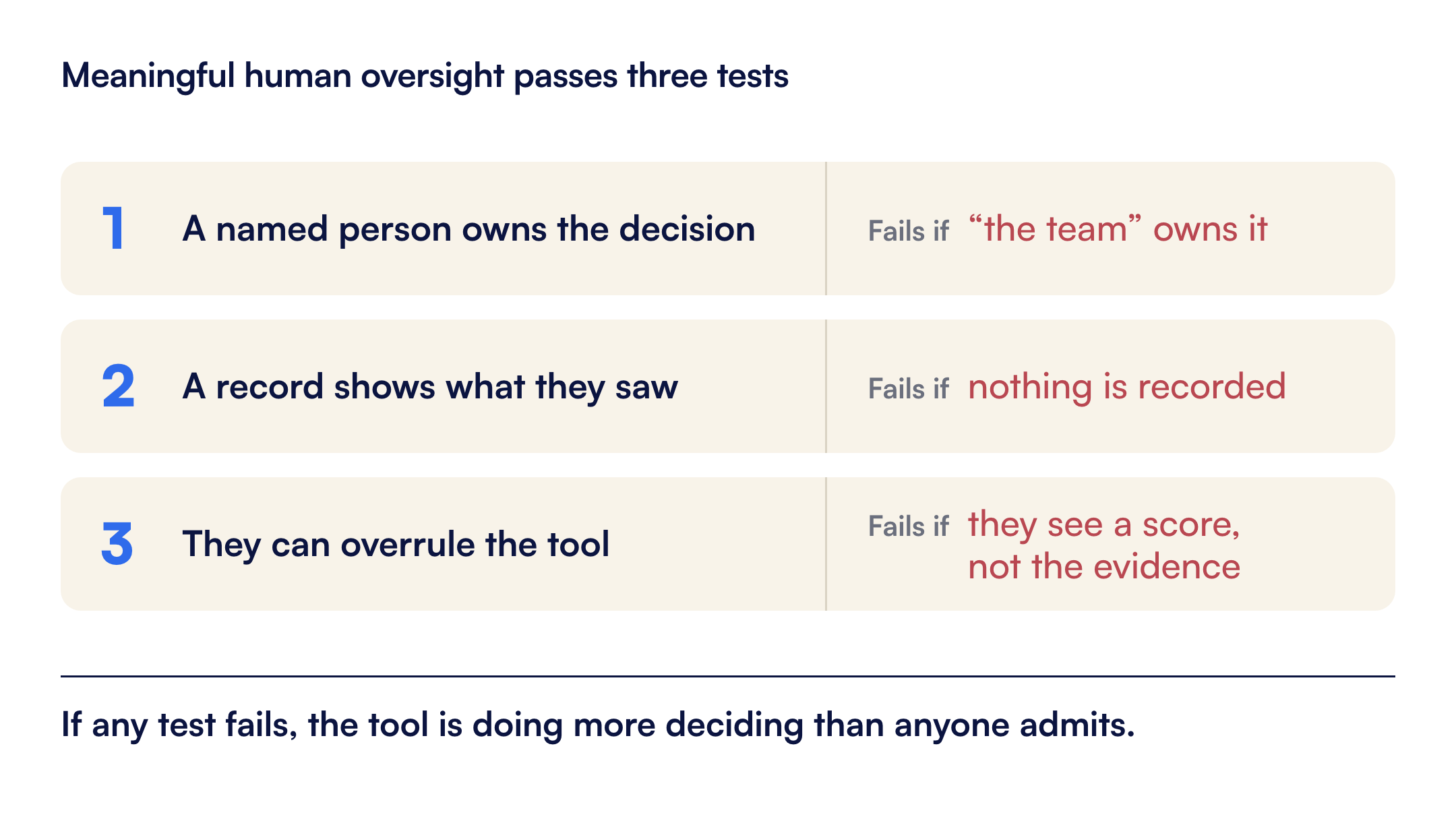
Meaningful oversight passes three tests: a named person owns the decision, a record shows what they saw, and that person can genuinely overrule the system.
"There is always a human in the loop" is the most common reassurance in AI hiring. It is not enough. A person who approves 340 rejections in one click, without seeing why each candidate was rejected, is in the loop. They are not deciding.
1. A named person owns the decision. Not "the team", not "the system", not "the client". A person whose name sits against the outcome, and who would be the one to explain it. In an agency setting, that means agreeing in advance whether the agency recruiter or the client makes the final call, and writing it down.
2. The decision is recorded. A record of what that person saw when they decided: which requirements were supported by evidence, which were only claimed, and which were missing. Without a record, nobody can check the decision later, including the person who made it.
3. The person can genuinely disagree with the system. They can see the evidence behind the output, not just a score. They have the authority to overrule it. And overruling it is a normal, recorded part of the work, not an exception that needs a justification. If recruiters never overrule anything, that is not proof the tool is perfect. It may be a sign that nobody is really looking.
If any of the three is missing, the tool is doing more deciding than anyone admits.
The decision should belong to someone
In the end, an employer hires a person. The employer is responsible for that decision, legally and practically. The supervisor lives with it every shift.
So the final hiring decision should be clearly owned by the employer or the recruiter. Not by the vendor, not by the model, and not by a filter that nobody remembers configuring.
That does not make technology less useful. It makes it useful in the right place.
How Radius Hire approaches it
Radius Hire is built on one principle, set out in The Radius Papers 01: A New Standard for Frontline Hiring. Technology supports the evaluation of candidates. People make the hiring decision.
Radius Hire asks every applicant the same structured questions, built on the requirements the employer sets, and shows the recruiter the evidence behind each requirement, labelled Proven, Claimed or Missing. It does not rank candidates or reject anyone on its own. A recruiter decides.
We do not claim this design removes bias or produces better hires. No published evidence shows that. What it does is keep the decision where accountability already sits.
Closing thought
The goal of hiring technology should not be to make recruiters disappear from the decision.
It should be to give them better evidence before they make it.
This is not about replacing recruiters. It moves them from running the process to making the decision.
So here is a question worth asking about your own process: for the last candidate you turned down, could you name the person who decided, show what they saw, and prove they could have said yes?
Read the full framework in The Radius Papers 01.