
Short answer: AI in hiring should evaluate candidates, not decide about them. Technology can ask every applicant the same job-related questions, organise the answers by requirement and show what is missing. People should read that evidence, challenge it and make the hire. The line matters most where volume is highest: frontline roles.
Most debates ask whether AI can do this. It usually can. The question that matters is who decides.
Key takeaways
- "AI in hiring" covers very different functions, from scheduling to automatic rejection. Separate them.
- Evaluation asks "what evidence do we have?" Decision asks "do we hire this person?" Technology can help with the first. People should own the second.
- Human oversight must be meaningful: a person with the evidence, the authority and the ability to overrule.
- Ranking candidates can move decision authority towards the tool, even when a person formally decides.
- Before you buy, ask one question: does this tool evaluate, or does it decide?
On this page: AI in hiring is not one thing · What is the difference between evaluating and deciding? · Where AI helps: the evaluation side · Should AI make hiring decisions? · Why does ranking candidates move the decision? · Who does what: a practical split · What this means for frontline hiring · Before you use AI: three questions · How Radius Hire applies this line · FAQ
AI in hiring is not one thing
Recruitment technology can perform very different functions:
- Sourcing: finding or targeting potential candidates.
- Application review: reading CVs or application forms and extracting information.
- Scheduling and administration: booking interviews, sending reminders.
- Structured interviewing: asking every candidate the same questions, by voice, video or text.
- Evidence collection: linking answers and documents to the requirements of a role.
- Summarisation: condensing interviews and documents for a recruiter.
- Verification: checking identity, right to work or certificates.
- Recommendation: suggesting which candidates to look at.
- Ranking: ordering candidates against each other by a score.
- Rejection: removing candidates from the process.
The first items on this list mostly help people work. The last items increasingly take decisions away from people. Treating all of them as the same "AI hiring" creates confusion in both directions. Some teams avoid useful tools because they fear automated rejection. Others adopt tools that decide more than they realise.
What is the difference between evaluating and deciding?
Evaluating establishes what evidence exists about a candidate against the role's requirements. Deciding is the choice to hire, and it is the part people should own.
Evaluation asks: what evidence do we have about this candidate against the requirements of the role? Decision asks: do we want to hire this person?
A decision draws on the evaluation, but it also weighs things an evaluation cannot contain: how many seats are open, which candidates are available now, what the supervisor knows about the team, what the candidate asked in their last message.
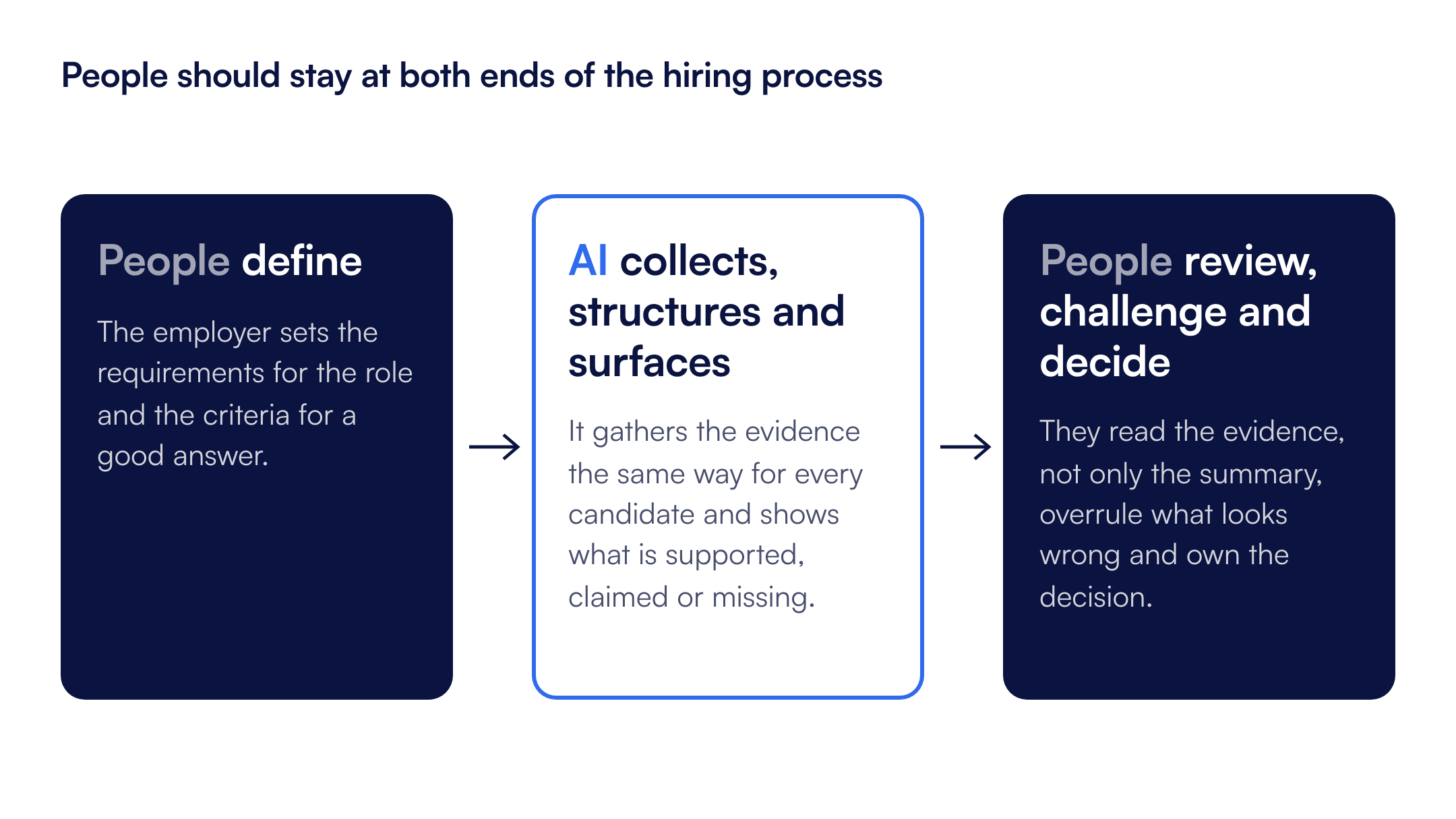
Technology can assist with evaluation. Responsibility for the decision should remain with the employer and the recruiter. One model keeps people at both ends:
- People define. The employer sets the requirements for the role and the criteria for a good answer.
- AI collects, structures and surfaces. It gathers the evidence the role requires in the same way for every candidate, organises it against the written requirements and shows what is supported, what is only claimed and what is missing.
- People review, challenge and decide. They read the evidence, not only the summary, overrule anything that looks wrong or incomplete, and make, record and own the decision.
The rest of this article uses that model to sort out what AI should and should not do.
Where AI helps: the evaluation side
Frontline hiring has a specific problem. The Signal Gap, a term Radius Hire introduced in The Radius Papers 01 (2026), is the distance between what a hiring decision rests on and what predicts the outcome. In many frontline processes, the decision rests on a CV, a short phone call and a start date. Important requirements, such as reliably reaching the site for a 05:30 start or accepting the real shift pattern, are never asked about before the offer.
The method with the strongest research support shows what could fill that gap. A structured interview asks every candidate the same job-related questions and rates each answer against a standard written in advance. Validity here is an estimated correlation between what a selection method says about candidates and their rated job performance, corrected for measurement error: 0 means no relationship, 1 a perfect one. On the revised 2022 estimates, structured interviews average 0.42, a moderate link to job performance, and the highest of the 25 methods reviewed. Unstructured interviews average 0.19. Years of job experience average 0.07 (Sackett and colleagues, 2022). These are averages from many studies, mostly outside the Netherlands, and they measure overall job performance, not retention.
The researchers behind the revised estimates note that, in their traditional in-person form, structured interviews are generally not a viable strategy for high-volume jobs, and that when technology takes over delivery, validity has to be checked again (Sackett and colleagues, 2022).
That is where technology can help: not by deciding, but by making the evidence-gathering people already value possible at volume. On the evaluation side, technology can:
- ask the same job-related questions of every candidate, at any hour, on a phone, in several languages
- collect structured information instead of free notes that differ per recruiter
- organise evidence by requirement, so the recruiter sees what is supported and what is missing
- summarise long interviews for faster review
- take over repetitive administration, such as scheduling and reminders
- keep the process consistent when the recruiter is tired or busy
Whether that keeps the method's validity in your workplace, only your own outcome data can show. Measure it.
Should AI make hiring decisions?
No. AI can support the evaluation, but the person accountable for a hire should be the person who decides it, with the evidence in front of them. These parts of hiring stay with people:
- Interpreting evidence. An answer rarely speaks for itself. A candidate who has never driven a reach truck but ran a forklift for two years may be a strong fit, or not.
- Considering context. The role, the site, the team and the candidate's circumstances all matter.
- Challenging an assessment. Any automated output can be wrong. Someone must be able to question it.
- Deciding whether evidence is sufficient. Is one claimed answer enough, or does this requirement need a check?
- Making the final hiring decision and being accountable for it.
This oversight must be meaningful. A person who clicks "approve" on every recommendation, without seeing the evidence or having the authority to disagree, is not really deciding. Three tests show whether a person really decides: a named owner, a record and a real ability to overrule.
The law points the same way. Under Article 22 of the GDPR, a decision about a candidate that has significant effects may not be based solely on automated processing, unless a narrow exception applies, such as necessity for entering into a contract. Guidance from European data protection authorities (WP251rev.01) adds that human involvement must be meaningful rather than a token gesture. It must come from someone with the authority and competence to change the decision.
AI used to recruit or select people is high-risk under Annex III of the EU AI Act. After the Digital Omnibus on AI (Regulation (EU) 2026/1744), the main high-risk duties apply from 2 December 2027. Some rules already apply: the ban on inferring emotions at work from biometric data such as face or voice (since 2 February 2025), AI literacy duties (since 2 February 2025), and the duty to tell people when they are interacting with an AI system (since 2 August 2026).
Article 14 requires providers to build high-risk systems so the people overseeing them can understand their limits, stay alert to over-reliance and override the output. Article 26(2) requires employers to give that oversight to people with the competence, training and authority to use it.
Why does ranking candidates move the decision?
A count shows, for each candidate, which requirements are supported by evidence, which rest only on a claim and which are missing, for example "meets 4 of 5 requirements with evidence". That is evaluation. A ranking orders candidates against each other, usually by a score, and quietly tells the recruiter where to start.
A ranking can move part of the decision into the tool, even when a person formally makes the final choice. Counting has limits too: a count is still an automated assessment, and an interview answer stays the candidate's own claim until someone checks it or rates it against written criteria.
Who does what: a practical split
Adjust this split for the role, the risk and the law.
| Hiring activity | Possible AI role | Human responsibility |
|---|---|---|
| Sourcing and job advertising | Suggest channels, help target advertisements, find potential candidates | Decide where and to whom the job is advertised; check advertisements are job-related and non-discriminatory |
| CV or application review | Extract information and show which requirements a candidate claims | Decide what is truly required; treat CV information as claims; review any filtering rule |
| Structured interview | Ask the same job-related questions of every candidate, at any hour, and record the answers | Write the questions and the criteria for a good answer; make sure candidates can reach a person |
| Evidence collection | Link each answer or document to the requirement it relates to | Judge whether the evidence is sufficient for each requirement |
| Summarisation | Condense interviews and documents for review | Check the underlying evidence where it matters; summaries can miss or distort detail |
| Verification | Check certificates earlier in the process; support identity and right-to-work checks at the point the law allows | Review every check; confirm the legal basis; handle errors and disputes |
| Candidate comparison | Show evidence per requirement for each candidate, side by side | Compare candidates and decide who to progress |
| Final decision | None beyond presenting the evidence | Decide, record who decided and on what evidence, and remain accountable |
| Candidate communication | Send updates, explain the process, and tell candidates they are dealing with AI (required since 2 August 2026) | Handle questions, complaints and difficult conversations; explain decisions |
In the Netherlands, an employer may check an applicant's identity by looking at the original document, but may not copy, scan or photograph it, or ask for the citizen service number (BSN), until the person is hired (Autoriteit Persoonsgegevens).
What this means for frontline hiring
Frontline hiring is where this line matters most, and where thoughtful technology can help most. Frontline roles are often filled quickly and in large numbers.
That creates a familiar tension. Volume and limited recruiter capacity push teams towards fast, thin decisions. Consistency is hard when every recruiter runs a slightly different phone screen. Candidates wait days for a call, or never hear back. Structured evidence is valuable but slow to collect by hand.
Technology can take on the repetitive, volume-heavy evaluation work: asking every candidate the same questions whenever they are available, and organising the answers. That leaves recruiters with the part that needs a person: reviewing evidence and deciding. The risk is the opposite design, where technology also takes on the deciding, quietly, through filters and rankings nobody inspects. The other risks of AI in hiring sit on the same line: over-reliance on output nobody checks, bias that nobody measures, and uses the law already restricts.
Before you use AI: three questions
Before adopting any tool, ask:
- Is it evaluating or deciding? Does it only collect and show evidence, or does it recommend, rank or reject?
- Can we see and challenge the evidence behind every output, and overrule it?
- Who is responsible for the final decision, and is that recorded?
How Radius Hire applies this line
We build for the evaluation side of this line. Radius Hire asks every applicant the same structured questions, built on the requirements the employer sets, and shows the recruiter the evidence behind each requirement, labelled Proven, Claimed or Missing. It does not rank candidates or reject anyone on its own. A recruiter decides.
Applicants answer by voice in their own language: Dutch, English, Polish, Romanian, Ukrainian, Russian or French. They are told at the start that the interviewer is automated and that a person reviews the result, and they can ask to speak with a recruiter instead.
Under Annex III we treat Radius Hire as a high-risk AI system and design it for human oversight ahead of 2 December 2027.
FAQ
What should AI do in recruitment?
AI is most useful for evaluation work where consistency and volume matter: asking every candidate the same job-related questions, organising answers by requirement, summarising information, handling scheduling and making evidence easy for recruiters to inspect.
What should AI not do in hiring?
It should not make the final hiring decision or reject candidates without a person reviewing their case, and it must not infer emotions at work, which the EU AI Act bans. The ban covers inferring emotions from biometric data such as a face or voice, with exceptions for medical or safety reasons. The European Commission's guidelines, which are not binding, say it also covers job candidates (C(2025) 5052 final).
What should recruiters be responsible for when using AI?
Writing or approving the job-related requirements and criteria, reviewing the evidence behind any output, challenging and overruling it where needed, making the final decision, and recording who decided and why.
How should humans and AI work together in recruitment?
People define the requirements and criteria. AI collects, structures and surfaces the evidence. People review it, challenge it and decide.
Sources
- Radius Hire (2026). The Radius Papers 01: A New Standard for Frontline Hiring. Sections 2, 3, 4, 7 and 8.
- Sackett, P. R., Zhang, C., Berry, C. M., and Lievens, F. (2022). Revisiting meta-analytic estimates of validity in personnel selection. Journal of Applied Psychology, 107(11), 2040 to 2068. DOI 10.1037/apl0000994
- Campion, M. A., Palmer, D. K., and Campion, J. E. (1997). A review of structure in the selection interview. Personnel Psychology, 50(3), 655 to 702.
- Regulation (EU) 2016/679 (GDPR), Article 22. EUR-Lex
- Article 29 Data Protection Working Party (2018). Guidelines on Automated individual decision-making and Profiling (WP251rev.01), endorsed by the European Data Protection Board. European Commission
- Regulation (EU) 2024/1689 (AI Act), as amended by Regulation (EU) 2026/1744: Articles 4, 5, 14, 26 and 50; Annex III, point 4(a). EUR-Lex
- European Commission. Guidelines on prohibited artificial intelligence practices established by Regulation (EU) 2024/1689, C(2025) 5052 final. Not binding. European Commission
- European Commission. AI Act: Shaping Europe's digital future (application timeline). European Commission
- Autoriteit Persoonsgegevens. Sollicitaties (guidance on job applications). Autoriteit Persoonsgegevens