
If you want to see time to hire and drop-off per role, site and source in one place, take a look at the Radius ATS.
On this page: What causes recruitment bottlenecks? · How do you find the bottlenecks in your recruitment process? · What if candidates leave where there is no long wait? · Which drop-outs can no process prevent? · Common mistakes · What does a misread bottleneck look like at an agency branch? · How Radius helps · FAQ
What causes recruitment bottlenecks?
The same wait between two steps can have different causes. A hiring delay is the time a candidate waits between one step and the next, for example between a screening call and a call about shifts. A bottleneck is the step where those waits build up.
- A step nobody owns. The step has no named owner, no deadline or no agreed note of what to pass on, so the candidate waits until someone notices. This is a handoff problem.
- An owner with too much work. The step has an owner, a deadline and a clear note, and the owner still cannot get to it in time. This is a capacity problem.
- A rise in volume. Waits can grow in busy periods, such as the run-up to Christmas, even when nothing in the process has changed.
Drop-out is a separate question. A candidate who stops answering is not always reacting to the wait. Pay, a site that is hard to reach, the shift pattern or a better offer can end an application where the process runs well.
How do you find the bottlenecks in your recruitment process?
Start with your records of real candidate journeys, not with a fix. How to Map Your Recruitment Process in Two Weeks shows how to time those journeys. For each symptom, check the first thing listed before you choose a fix. The table is our reading of the rules for reading a handoff review in Radius Hire's 2026 research paper on frontline hiring handoffs.
| Symptom | Check first | What it points to |
|---|---|---|
| A long wait at one handoff | The owner's workload, and who covers when they are away | If the owner is overloaded: workload or cover, not handoff design |
| A long wait, and the owner has time | Is there one named owner, a deadline and someone told when it is missed? | A handoff fix |
| Candidates leave where waits are short and nothing is asked twice | Pay, travel distance, the job itself | Probably not a handoff problem |
| Long silence and repeated requests at the same point where candidates leave | Recorded drop-out reasons; candidates who agreed to talk | A likely handoff problem worth fixing first |
| Waits suddenly rise | Compare with a similar period, such as the peak before Christmas last year | Seasonal volume, which changes waits on its own |
Illustration built for this post, not client data.
The fourth row deserves the closest look. Where long silence, repeated requests and drop-outs meet at the same step, a handoff fix is the most likely to pay off.
To fill in the table, talk to the people involved. The paper suggests fifteen minutes each with the recruiter, the planner, the administrator and the site lead: what do they receive, what is usually missing, and what do they have to chase? An overloaded planner and an unclear handoff sound different in that conversation.
What if candidates leave where there is no long wait?
Then the cause is probably not the handoff. Look at pay, travel distance and the job itself. Where candidates do leave during a long wait, see why good candidates drop out while they wait for a call.
Research points to practical causes too. A survey of applicants for an entry-level position at several locations found that their reasons for withdrawing were best described as practical obstacles, such as the distance to the testing site, rather than differences between minority groups or views on whether the job suited them (Brock Baskin, Zeni and Buckley, 2014). Some obstacles, such as where and when you hold an interview, are in your control.
Before you contact candidates who dropped out, check with whoever handles privacy in your organisation. The paper suggests asking only those who agreed to be contacted, and only where your privacy notice allows it. Ask about the job and the process, never about health.
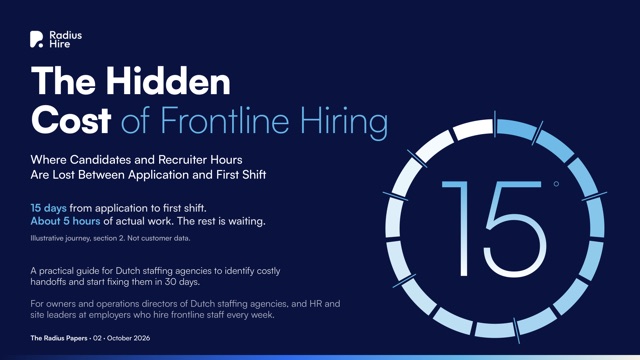
Want the research on where candidates are lost? The Radius Papers 02: The Hidden Cost of Frontline Hiring is a free white paper for teams hiring frontline workers in the Netherlands, covering where candidates and recruiter hours are lost between application and first shift. Enter your name and work email, choose English or Dutch, and Radius emails it to you: get the white paper.
Which drop-outs can no process prevent?
No process prevents drop-outs caused by a better offer or a change at home. The paper says the evidence cuts both ways: fixing every handoff will not stop all drop-out.
People who withdraw are also not one group. A study of 3,550 police applicants found that those who withdrew differed from those who stayed in most of the areas measured (Ryan, Sacco, McFarland and Kriska, 2000). A second study asked 196 people who had withdrawn from a police officer selection process for their main reason. Female and minority applicants appeared to give different reasons from male and White applicants (Ployhart, McFarland and Ryan, 2002). Both studies come from police hiring, not frontline hiring in the Netherlands. They are a reminder that one average reason may not explain everyone who leaves.
Common mistakes
Adding a deadline when the owner is overloaded. Deadlines and alerts help where a step has no clear owner. They do not create hours. Fix: look at workload and cover first. The case is set out in Frontline Hiring Does Not Have a Knowledge Problem. It Has a Capacity Problem., and How to Run Structured Interviews at High Volume includes a simple workload model.
Blaming the wait for every drop-out. Fix: check where candidates actually left, using the stage and reason you recorded. A recruitment report that shows the wait between steps makes this easier to see.
Comparing a busy month with a quiet one. Fix: compare like with like, such as this year's peak before Christmas with last year's.
Turning a process review into a review of people. Fix: rate handoffs, not people. If the answer is overload, fix workload or cover. If you want to track how fast each person responds over time, talk to your legal adviser and, where you have one, your works council first.
Keeping a fix that does not work. Fix: measure again on the same number of candidates. The paper suggests doing this 30 days after the fix goes live, and stopping a fix that does not move waiting time or drop-outs. Remember that 20 to 30 candidate journeys show patterns, not statistically reliable rates.
What does a misread bottleneck look like at an agency branch?
The weekly review is not going well for the planner. Candidates wait several days between their screening call and a call about shifts. Two have already taken other jobs. The branch manager has a fix ready: a one-working-day deadline on the planner's handoff, with an alert when it is missed.
Then someone asks how many sites the planner covers. The answer is three. Since the spring, she has been doing work that used to be split between two people.
This scene is a composite, not a documented case.
The handoff was not broken. The planner was overloaded. A deadline would have added an alert to her day, and not one extra hour.
How Radius helps
Radius Hire is an AI hiring platform for frontline roles, built in Amsterdam for staffing agencies and employers who hire for the work floor. The Radius platform is built to keep one pipeline from applied to signed per role, site and client, and to report time to hire, drop-off and cost per hire per role, site and source. That shows you where to look; your team still decides what the cause is.