On this page: Key takeaways · What are deskless workers? · What changes when you hire for a job without a desk? · How should deskless candidates apply? · When should you contact deskless candidates? · What should you assess instead of a CV? · What does this mean for staffing agencies? · Where does this approach need care? · How Radius helps · FAQ
Key takeaways
- Most hiring processes assume office hours, an inbox and a CV. Deskless hiring works better without all three.
- In 2024, 23 per cent of working people in the Netherlands usually or always worked evenings, nights or weekends (CBS).
- Check documents before the first shift, and keep a person making every decision.
What are deskless workers?
Deskless workers are people whose work happens away from a desk.
There is no official statistic for "deskless", but there are proxies. In 2023, 52 per cent of working people in the Netherlands sometimes or usually worked from home. In transport and logistics occupations, 0.9 per cent usually did and 4.1 per cent sometimes did (CBS, 15 March 2024). Across the EU, the European Commission's Joint Research Centre estimated in 2020 that around 37 per cent of employees work in occupations that can technically be done from home (JRC). The rest cannot.
A widely repeated figure says 80 per cent of the global workforce is deskless. We found no official statistic behind it, so we leave it out.
What changes when you hire for a job without a desk?
Four office assumptions stop working: the inbox, the calendar, the CV and the wait.
| Office assumption | Deskless reality | What to change |
|---|---|---|
| Candidates read email at a desk | They apply and reply on a phone, often between shifts | Short messages, a form built for a phone, no account or attachment |
| Interviews happen between 9:00 and 17:00 | Many work evenings, nights or weekends | A first step they can take at any hour; early and late call slots |
| The CV shows who fits | CVs are short or missing; the job turns on certificates, shift times and physical tasks | Ask about each requirement directly |
| A reply next week is fine | Every day without a reply is a day to take another job | Reply the same day with a clear next step |
Test your process as a candidate would: on a phone, at 22:00, after a shift. To see how a structured voice interview works on a phone, look at the AI Interviewer.
How should deskless candidates apply?
On a phone, in a few minutes, without a CV or an account.
In 2025, 96 per cent of people aged 12 and over in the Netherlands went online with a mobile phone, more than with any other device (CBS, 10 February 2026). A form that needs a password, a laptop or an upload loses people.
- Ask only what the next step needs: a name, a phone number, the shift and the deciding requirements.
- Let candidates add a CV if they have one. Do not require it.
- Put shift times, location and start date in the job ad, so candidates can rule themselves out. We argue this in Tell Candidates About the 05:30 Start.
When should you contact deskless candidates?
When they are free, which is often outside office hours.
In 2024, 2.3 million people in the Netherlands, 23 per cent of the working population, usually or always worked in the evening, at night or at the weekend; another 47 per cent sometimes did. In service occupations the share was 52 per cent (CBS, 9 January 2026). Across the EU, 22.4 per cent of employed people usually worked at weekends in 2023 (Eurostat, 1 May 2025).
Working evenings, nights or weekends, Netherlands, 2024
Share of the working population; 23 per cent is 2.3 million people
A call at 11:00 reaches a night worker asleep and a day worker on the floor. So make the first step one the candidate can complete alone, at any hour, add early and late call slots, and confirm each next step in a message.
What should you assess instead of a CV?
The job's actual requirements, asked directly, with evidence for each.
A CV records what someone chose to write about themselves. The deciding facts for a deskless role are often missing: whether the candidate can start at 05:30, holds a valid reach truck certificate or can work weekends. So ask.
A 2023 review of selection research found that predictors built for the specific job, such as structured interviews, "tend to fare better than more general measures" (Sackett et al., 2023). For most deskless roles, that means a short structured interview about the requirements. See How to Run Structured Interviews at High Volume.
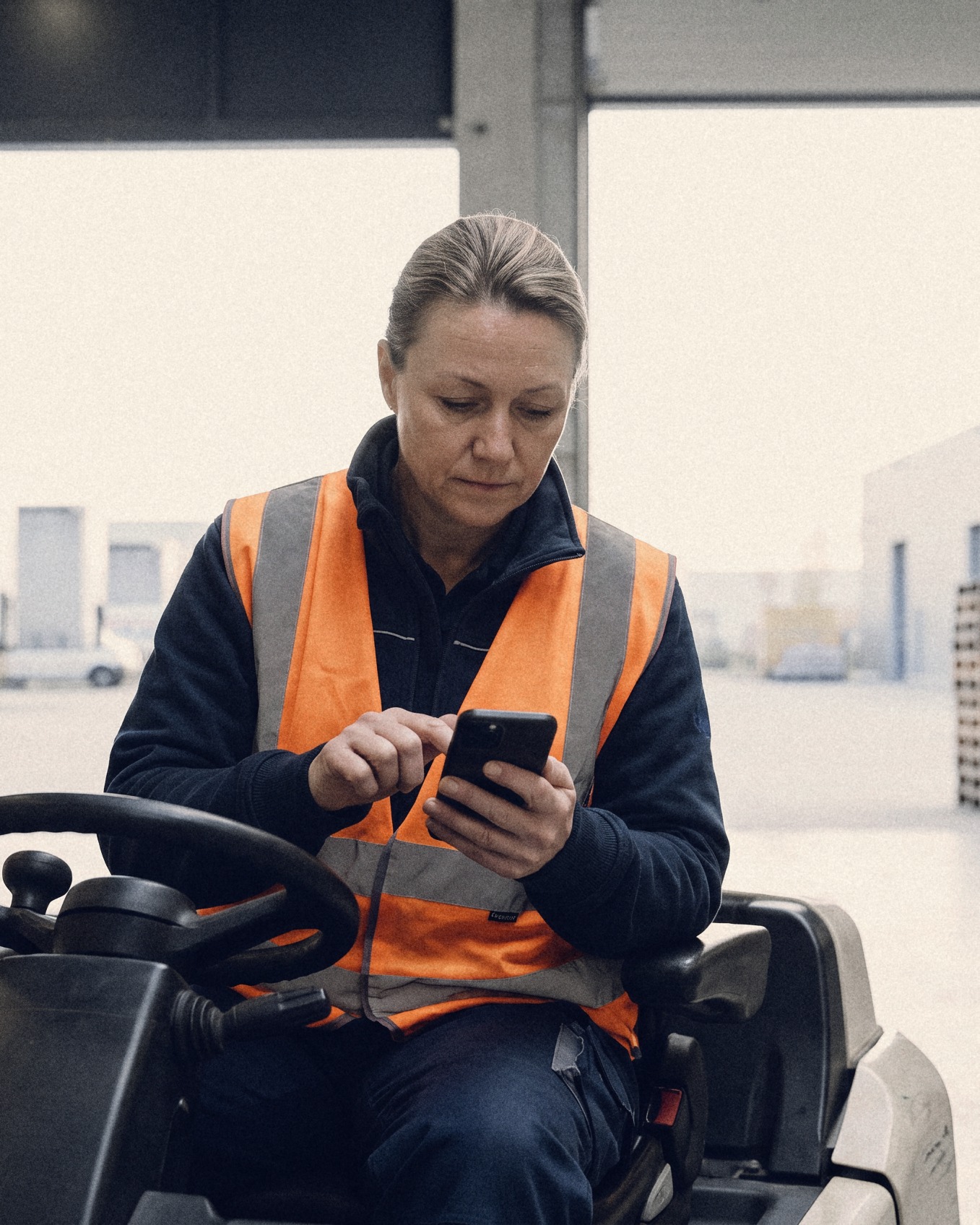
Illustrative example. An agency needs order pickers for a 05:30 shift, reach truck certificate required. A candidate applies on her phone at 22:40, after an evening shift elsewhere, and answers questions on early starts, weekends, reach truck experience, certificate expiry and start date. Next morning the recruiter reviews her answers against each requirement, asks to see the certificate and calls her at 16:00. Nobody needed her CV.
Deskless hiring checklist
- Can a candidate apply on a phone in a few minutes, with no account and no CV required?
- Does the job ad state shift times, location and start date?
- Can candidates complete the first step outside office hours?
- Does every requirement have a direct question?
- Are certificates and documents checked before the first shift?
- Does a person review every candidate before anyone is turned away?
- Is there a route for candidates who do not apply by phone?
What does this mean for staffing agencies?
Agencies feel it most: deskless hiring is their weekly routine.
Each client brings its own shifts and certificates, so set requirements per role. A candidate who is wrong for one client this week may suit another next week, so keep the answers and checks rather than asking twice. Give overnight applications an owner who clears them first thing.
Where does this approach need care?
Some deskless roles still need a step in person.
Physical trials, site inductions and driving assessments need a visit: use the phone for the first step and save time in person for what only a visit can show. A quick first step is also only fair if every candidate gets the same questions and a person looks at every result.
How Radius helps
Radius Hire is the AI hiring platform for frontline roles. It puts a short, structured interview and the evidence for each requirement on one candidate record.
- The AI Interviewer runs a short, structured voice interview that candidates can take on their phone, whenever it suits them, in the language set for the role. Candidates are told at the start that the interviewer is automated and that a person reviews the result.
- Match shows, for each requirement, whether it is backed by a document or a check, rests only on what the candidate said, or is still missing.
- Where the employer uses Radius Passport, identity and right to work are checked with a trusted verification partner and certificates are recorded with their expiry dates, so a recruiter can review the evidence before an offer.
- Radius never rejects a candidate on its own. A recruiter reviews the evidence and makes every hiring decision. See how this works by sector on Industries and for staffing agencies on For agencies.