
Short answer: A Dutch staffing agency must check a candidate's original ID before putting them forward or placing them, and keep a copy. It must destroy that copy within four weeks, unless the person becomes its employee. Government guidance says clients keep no copy for EEA or Swiss workers. Under the GDPR, whoever controls candidate data must inform the candidate.
This guide covers GDPR for recruitment agencies and their clients in the Netherlands, together with the Dutch rules on ID copies.
If you run an agency, see how Radius for agencies keeps every client's roles in one workspace, with permissions per team.
Key takeaways
- Before hiring: the agency destroys its ID copy once it is no longer needed, and at the latest four weeks after it entered its records (Waadi, Article 7c, law in force).
- After hiring: the agency, now the employer, keeps the copy in its payroll records until at least five years after the end of the calendar year in which the employment ended (law in force).
- Clients: government guidance says they keep no copy for EEA or Swiss workers. For other workers, the Wav requires one.
- Roles: in a typical placement, agency and client are separate controllers, each with its own duty to inform the candidate (our reading of EDPB guidance).
- At registration: the Dutch Data Protection Authority says no BSN and no health questions, and criminal data goes to a client only where necessary.
On this page: Who may hold a copy of a candidate's ID, and for how long? · Can a staffing agency keep a copy of a candidate's ID? · What changes once the candidate becomes the agency's employee? · May the client keep a copy of an agency worker's ID? · What may an agency ask for at registration? · What must candidates be told under the GDPR, and by whom? · GDPR roles for recruitment agencies: who is responsible for candidate data? · What should the agency pass on to the client? · Do automated assessments or AI tools change the rules? · How do you reduce the number of ID copies? · How Radius helps · FAQ
A compliance officer at an agency branch in Eindhoven types "paspoort" into the search bar of the shared recruitment inbox. The results include candidates who registered last spring and never worked a shift. The planner's spreadsheet has a tab of photos someone pasted in on a busy Monday. Every copy was made for a reason. Nobody decided how long any of them should live.
This scene is a composite, not a documented case.
When a candidate moves from agency to client, their data moves too, and each copy is one more place where the General Data Protection Regulation (GDPR) requires it to be accurate, secure and kept no longer than needed (Article 5(1)(d) to (f)). This article follows staffing agency candidate data under the GDPR and Dutch law, before and after hiring. We label each point as law in force, official guidance or our own reading, and mark recommended safeguards as good practice.
Who may hold a copy of a candidate's ID, and for how long?
It depends on who holds it, the stage, and the worker's nationality.
| Who and when | Copy of the ID? | How long | Source and type |
|---|---|---|---|
| Agency, before placing a candidate or putting them forward | Yes, after checking the original | Until no longer needed for the identity check, four weeks at most from entering the records | Waadi, Article 7c (law) |
| Agency, once the candidate is its employee | Yes, in the payroll records | At least five years after the end of the calendar year in which the employment ended | Wage Tax Implementing Regulation 2011, Article 7.5 (law) |
| Agency, self-employed person taking an assignment through it | No | No copy | Dutch Data Protection Authority (guidance) |
| Client, worker from the EEA or Switzerland | No. It checks the original and records personal details. | No copy | Rijksoverheid; Ondernemersplein (guidance) |
| Client, worker from outside the EU, EEA and Switzerland | Yes, received from the agency | At least five years after the end of the calendar year in which the work ended | Wav, Article 15 (law) |
| Employer hiring directly, during the application | No. It may look at the original. | No copy until the person is hired | Dutch Data Protection Authority (guidance) |
Checked on 20 October 2026 against the sources listed below.
Can a staffing agency keep a copy of a candidate's ID?
Yes, but before hiring only briefly. Article 7c of the Waadi (Wet allocatie arbeidskrachten door intermediairs), the Dutch law on placing workers through intermediaries, is law in force:
- The candidate provides a passport, ID card or foreign nationals' document listed in the Identification Duty Act (Wet op de identificatieplicht, Article 1(1), points 1 to 3). A driving licence is not among them.
- Before placing the candidate or putting them forward to a client, the agency establishes their identity from that document, and keeps a copy (Article 7c(2) and (3)).
- It destroys the copy as soon as it no longer needs it for that check, and at the latest four weeks after the copy entered its records (Article 7c(4)).
- This does not apply where the agency has the payroll-tax duty to keep the copy (Wage Tax Act 1964, Article 28(1)(f)). See the next section.
Four weeks is a maximum, counted from when the copy enters the records, not from the end of the registration. A copy from last spring, for someone who never worked a shift, should be gone.
The Dutch Data Protection Authority (Autoriteit Persoonsgegevens, AP) adds two points. A candidate may black out their citizen service number (BSN) on the copy, because the agency may not record it at registration. And an agency may not copy the ID of a self-employed person (zzp'er) who takes an assignment through it. In our reading, that fits a genuinely self-employed assignment, since Article 7c covers people placed under a client's supervision and direction, or helped into an employment contract. If a "self-employed" assignment is in fact such a placement, Article 7c may apply after all.
What changes once the candidate becomes the agency's employee?
Payroll-tax rules replace the four-week rule. Article 28(1)(f) of the Wage Tax Act 1964 (Wet op de loonbelasting 1964) applies to an employee receiving wages from current employment. In our reading, the exception in Article 7c therefore starts when the person actually enters the agency's employment, not at registration. The AP says the same.
The Wage Tax Implementing Regulation 2011 (Uitvoeringsregeling loonbelasting 2011), Article 7.5, law in force, sets the details:
- The employer establishes identity before the date work starts and keeps a copy in the payroll records, noting the document type and number if the copy does not show them (Article 7.5(1) and (2)).
- It keeps the copy for at least five years after the end of the calendar year in which the employment ended (Article 7.5(4)).
Rijksoverheid and Ondernemersplein use the same calendar-year rule. The AP's shorter wording, time in service plus five years, is a simplification; use the regulation's. The general seven-year rule for tax records (General Tax Act, Article 52(4)) applies only where tax law sets no other period. In our reading, Article 7.5(4) is that other period.
In practice, in our reading of these texts:
- If more than four weeks pass between registration and the first contract, the registration copy should already be gone. Check the original again before work starts and make the payroll copy then.
- Five years is a minimum. Ondernemersplein says to destroy the copy once the retention duty ends.
- The agency may now ask for the BSN (AP), and Rijksoverheid says it must be legible on the copy.
Employers that hire directly: the AP says an employer may look at an applicant's original ID but may not copy, scan or photograph it during the application. Verifying Frontline Candidates: Which Identity, Right to Work and Certificate Checks Can Happen Before the Offer? covers checks before the offer.
May the client keep a copy of an agency worker's ID?
Usually not, according to government guidance. Rijksoverheid says a company that hires an agency worker (the inlener) checks the original ID itself before work starts but may not keep a copy, because the agency is the employer. Ondernemersplein adds that the client records the worker's personal details. We found no statute that sets this general check for EEA and Swiss workers, so treat it as guidance. For the hirer's own checks and fines, see Hiring agency workers: Dutch chain liability, checks and Wav fines.
The exception is a worker from outside the EU, EEA and Switzerland. Under the Wav (Wet arbeid vreemdelingen), the agency must make sure the client receives a copy of the worker's ID without delay once work starts. The client checks identity against it, files it, and keeps it until at least five years after the end of the calendar year in which the work ended (Article 15(1) to (4), law in force).
If an agency forwards a scan for an EEA worker anyway, the client holds a copy that guidance says it should not keep.
What may an agency ask for at registration?
Only what it needs to place the candidate. Each use of data needs a lawful basis under GDPR Article 6(1), such as steps at the candidate's request before a contract, a legal obligation, or a legitimate interest, and data must be limited to what is necessary (Article 5(1)(c)).
Consent is rarely the right basis. The AP says applicants depend on the organisation, so their consent is not freely given. The European Data Protection Board (EDPB) calls relying on the consent of current or future employees problematic, though not ruled out in every case.
What the AP says an agency may not do at registration (official guidance):
- Ask for the BSN, except to check with the UWV whether the candidate belongs to the target group of the Dutch jobs agreement for people with a work disability. The law behind this is Article 46 of the Dutch GDPR Implementation Act (Uitvoeringswet AVG, UAVG): a national ID number may be used only to carry out the law that requires it, or for purposes set by law.
- Ask about health or past sickness absence. Health data is a special category the UAVG prohibits processing unless an exception applies (Article 22).
- Pass criminal data to the client as a matter of course. Only where necessary, after checking proportionality and less intrusive options. UAVG Article 33(4) allows criminal data to be processed for a third party only in limited cases, chiefly by holders of a licence under the Private Security Organisations and Detective Agencies Act (Wpbr), and the AP says screening for a client needs that licence.
Candidate data retention: no law sets a period for an agency's candidate pool. The GDPR rule is no longer than needed (Article 5(1)(e)), so set and document one. For an employer's own applicants, AP guidance is deletion usually within four weeks after the procedure ends, or up to one year with consent.
What must candidates be told under the GDPR, and by whom?
Every controller must tell them. A controller decides, alone or with others, why and how personal data is processed (Article 4(7)); a processor works on a controller's behalf (Article 4(8)).
The agency, at collection: who it is, why it uses the data, on what legal basis, and who receives it, including clients by name or category (Article 13(1)).
The client, within a month: a client that receives the data and is a controller must inform the candidate itself, including where the data came from. At the latest, it does so within one month, or at first contact or first disclosure if earlier (Article 14(2)(f) and (3)).
Does the agency's notice cover the client? Only where and insofar as the candidate already has the information the client must give (Article 14(5)(a)). EU transparency guidance, endorsed by the EDPB, says the Article 14 exceptions should be read narrowly, and that a controller relying on what a person already knows must be able to show it. Naming the client as a recipient does not tell the candidate the client's own purposes, retention period or contact details. In our reading, the client should usually give its own short notice, for example at the ID check before the first shift.
Good practice: an agency can hand over the client's notice with the shift details, in line with the one notice per move that Radius Hire's 2026 research paper on frontline hiring handoffs suggests.
GDPR roles for recruitment agencies: who is responsible for candidate data?
It depends on what each party actually decides. The EDPB says roles follow actual activities, not the label in a contract (Guidelines 07/2020, paragraph 12). Three patterns fit agency work:
- Separate controllers: exchanging data without jointly determined purposes or means is a transmission between separate controllers (paragraph 70), as in the EDPB's travel agency example. In our reading, a standard placement fits here: the agency places and employs the worker, and the client plans shifts and admits the worker on site.
- Joint controllers: the EDPB's headhunter example finds joint control where recruiter and company feed one candidate-matching service, while the company alone controls its later hiring steps. Joint controllers must agree who informs the candidate (GDPR Article 26(1)).
- Controller and processor: where one party only processes data on the other's behalf, with no purpose of its own, a contract under Article 28(3) is required.
Good practice: record the role for each data flow between agency and client, and check that both privacy notices match.
What should the agency pass on to the client?
Only what the client needs for the placement (GDPR, Article 5(1)(b) and (c)). For a first shift, Radius Hire's research paper suggests sending the practical details the day before: a name list, the start time, and slots for the ID check and the induction. For an EEA or Swiss worker, that does not include an ID copy.
Do automated assessments or AI tools change the rules?
Yes, if no person makes the decision. Under GDPR Article 22, candidates may not be subject to a decision based solely on automated processing with legal or similarly significant effects. The AP says a fully automated score that decides an application affects the applicant significantly in almost all cases. For an employer or agency, it names two routes: the decision is necessary to enter into a contract, or the candidate gives explicit consent, which it calls less obvious. The candidate can then obtain human intervention, give their view and contest the decision (Article 22(3)), and must be told beforehand.
There is no automated decision, the AP says, where a competent person can change or overrule the outcome in practice. A person who must always follow the score does not count.
When is a data protection impact assessment (DPIA) needed? Where processing is likely to be high risk, in particular systematic and extensive automated evaluation, including profiling, behind decisions with significant effects (Article 35(3)(a)). The AP's mandatory DPIA list includes profiling such as assessing work performance, and blacklists of worker misconduct shared with third parties, naming agencies as an example. Otherwise the AP's rule of thumb is a DPIA where two or more of the European regulators' nine criteria apply. The EU AI Act adds separate rules, outside this article: see the EU AI Act in recruitment.
How do you reduce the number of ID copies?
Count them first. Radius Hire's research paper treats ID copies differently from every other item in its cost table: "Not a cost: count it and aim to reduce it".
Good-practice steps, drawn from the paper:
- List every place a copy can sit: shared inboxes, spreadsheets, messaging apps, the applicant tracking system (ATS), anything forwarded to a client.
- Give each an owner and a deletion date using the legal periods above.
- Stop copies travelling: no copy to a client for an EEA or Swiss worker.
- Keep audits free of ID data, including an audit of your hiring process for one role.
- Count again 30 days after a fix goes live.
How Radius helps
Radius Hire is an AI hiring platform for frontline roles, built in Amsterdam for staffing agencies and employers who hire for the work floor. It is built to source, interview and verify applicants, while a person makes every hiring decision. In the Radius ATS, WhatsApp and email threads, notes, the interview, offers and contracts sit on one candidate record, and agencies run every client's roles in one workspace with permissions per team. Each verification check keeps its source and its date, and candidate data is hosted in the EU. That gives your team one place to look when you count where candidate data sits. Which copies you keep, and for how long, stays your decision.
FAQ
How long may an employer keep a copy of an employee's ID?
At least five years after the end of the calendar year in which the employment ended, under Article 7.5(4) of the Wage Tax Implementing Regulation 2011. It is a minimum, and Ondernemersplein says the copy must then be destroyed.
May an agency ask for a candidate's BSN at registration?
No, according to the AP, except for a UWV check for the jobs agreement target group. The BSN may be requested once the person enters the agency's employment.
Should an agency email ID copies to the client?
Not for a worker from the EEA or Switzerland: guidance says the client keeps no copy. For other workers the Wav requires the client to receive one once work starts. Use a secure channel, not a shared inbox or chat app.
Does the agency's privacy notice cover the client?
Usually not on its own. The client is excused only insofar as the candidate already has everything the client must tell them, and naming the client as a recipient does not cover its own purposes or retention.
Is the GDPR about to change?
Not yet. In November 2025 the European Commission put forward changes known as the Digital Omnibus. In October 2026 the European Parliament still listed it as awaiting a committee decision, so the GDPR applies unchanged.
Sources
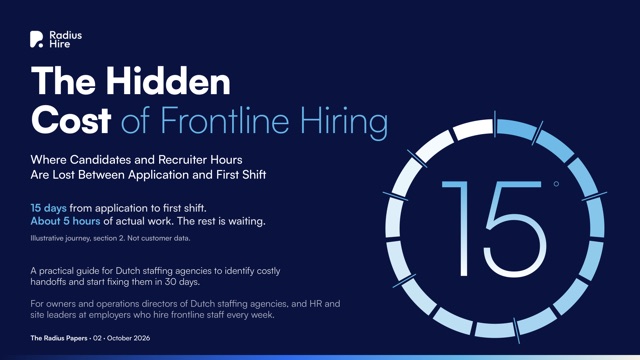
- Radius Hire (2026). The Radius Papers 02: The Hidden Cost of Frontline Hiring. White paper. https://radiushire.com/white-papers/radius-papers-02.
- Government of the Netherlands (2026). Wet allocatie arbeidskrachten door intermediairs (BWBR0009616), Articles 1 and 7c, version in force from 1 July 2026. Statute. https://wetten.overheid.nl/BWBR0009616/2026-07-01, accessed 20 October 2026.
- Government of the Netherlands (2026). Wet op de loonbelasting 1964 (BWBR0002471), Article 28, version in force from 8 October 2026. Statute. https://wetten.overheid.nl/BWBR0002471/2026-10-08, accessed 20 October 2026.
- Government of the Netherlands (2026). Uitvoeringsregeling loonbelasting 2011 (BWBR0028236), Article 7.5, version in force from 1 September 2026. Ministerial regulation. https://wetten.overheid.nl/BWBR0028236/2026-09-01, accessed 20 October 2026.
- Government of the Netherlands (2026). Algemene wet inzake rijksbelastingen (BWBR0002320), Article 52, version in force from 1 October 2026. Statute. https://wetten.overheid.nl/BWBR0002320, accessed 20 October 2026.
- Government of the Netherlands (2026). Wet op de identificatieplicht (BWBR0006297), Article 1, version in force from 1 October 2026. Statute. https://wetten.overheid.nl/BWBR0006297, accessed 20 October 2026.
- Government of the Netherlands (2026). Wet arbeid vreemdelingen (BWBR0007149), Article 15, version in force from 12 June 2026. Statute. https://wetten.overheid.nl/BWBR0007149/2026-06-12, accessed 20 October 2026.
- Government of the Netherlands (2026). Uitvoeringswet Algemene verordening gegevensbescherming (BWBR0040940), Articles 22, 33 and 46, version in force from 1 September 2026. Statute. https://wetten.overheid.nl/BWBR0040940, accessed 20 October 2026.
- European Union (2016). Regulation (EU) 2016/679 (General Data Protection Regulation), Articles 4, 5, 6, 13, 14, 22, 26, 28 and 35. Regulation. https://eur-lex.europa.eu/legal-content/EN/TXT/HTML/?uri=CELEX:02016R0679-20160504, accessed 20 October 2026.
- Autoriteit Persoonsgegevens (2025). Inschrijven bij een uitzendbureau. Official guidance, updated 2 January 2025. https://www.autoriteitpersoonsgegevens.nl/themas/werk-en-uitkering/uitzendbureau/inschrijven-bij-een-uitzendbureau, accessed 20 October 2026.
- Autoriteit Persoonsgegevens (2025). Werken via een uitzendbureau. Official guidance, updated 2 January 2025. https://www.autoriteitpersoonsgegevens.nl/themas/werk-en-uitkering/uitzendbureau/werken-via-een-uitzendbureau, accessed 20 October 2026.
- Autoriteit Persoonsgegevens (2025). Persoonsgegevens van sollicitanten. Official guidance, updated 2 January 2025. https://www.autoriteitpersoonsgegevens.nl/themas/werk-en-uitkering/sollicitaties/persoonsgegevens-van-sollicitanten, accessed 20 October 2026.
- Autoriteit Persoonsgegevens (n.d.). Online- en game-based assessments bij werving en selectie: regels voor geautomatiseerde besluitvorming. Official guidance. https://www.autoriteitpersoonsgegevens.nl/themas/werk-en-uitkering/sollicitaties/online-en-game-based-assessments-bij-werving-en-selectie-regels-voor-geautomatiseerde-besluitvorming, accessed 20 October 2026.
- Autoriteit Persoonsgegevens (2026). Data protection impact assessment (DPIA). Official guidance, updated 14 August 2026. https://www.autoriteitpersoonsgegevens.nl/themas/basis-avg/praktisch-avg/data-protection-impact-assessment-dpia, accessed 20 October 2026.
- Autoriteit Persoonsgegevens (2019). Besluit inzake lijst van verwerkingen van persoonsgegevens waarvoor een gegevensbeschermingseffectbeoordeling (DPIA) verplicht is, Staatscourant 2019, 64418. Decision. https://zoek.officielebekendmakingen.nl/stcrt-2019-64418.html, accessed 20 October 2026.
- European Data Protection Board (2021). Guidelines 07/2020 on the concepts of controller and processor in the GDPR, version 2.1, paragraphs 12, 68 to 70 and examples. Guidance. https://www.edpb.europa.eu/system/files/2023-10/EDPB_guidelines_202007_controllerprocessor_final_en.pdf, accessed 20 October 2026.
- European Data Protection Board (2020). Guidelines 05/2020 on consent under Regulation 2016/679, version 1.1, paragraphs 21 and 22. Guidance. https://www.edpb.europa.eu/system/files/documents/files/file1/edpb_guidelines_202005_consent_en.pdf, accessed 20 October 2026.
- Article 29 Working Party (2018). Guidelines on transparency under Regulation 2016/679 (WP260 rev.01), paragraphs 56 and 57, endorsed by the EDPB. Guidance. https://ec.europa.eu/newsroom/article29/items/622227, accessed 20 October 2026.
- Rijksoverheid (n.d.). Wat moet ik als werkgever doen om te voldoen aan de identificatieplicht? Official guidance (questions and answers). https://www.rijksoverheid.nl/documenten/vraag-en-antwoord/identificatieplicht/wat-moet-ik-als-werkgever-doen-om-te-voldoen-aan-de-identificatieplicht, accessed 20 October 2026.
- Ondernemersplein (n.d.). ID-bewijs controleren en bewaren. Official guidance. https://ondernemersplein.overheid.nl/identiteitsbewijs-controleren-en-bewaren/, accessed 20 October 2026.
- European Parliament, Legislative Observatory (2026). Simplification of the digital legislative framework: Digital Omnibus (procedure 2025/0360(COD)). Procedure file. https://oeil.europarl.europa.eu/oeil/en/procedure-file?reference=2025/0360(COD), accessed 20 October 2026.
This article is general information, not legal advice. Legal points were checked against official sources on 20 October 2026.