
Imagine opening your screening tool and seeing 40 candidates for a warehouse role, sorted from top to bottom by a score.
Where do you start reading? At the top, like everyone else. And when do you stop? Probably when you have enough people for interviews, somewhere around number twelve.
Nobody decided that candidate 31 was unsuitable. But in practice, the ordering made that decision for you.
This scene is a composite, not a documented case.
That is why Radius Hire does something different. We count, don't rank.
What does it mean to count evidence instead of ranking candidates?
Counting means showing how many of the job's requirements each candidate meets with evidence, for example "meets 4 of 5 requirements with evidence", instead of ordering candidates against each other.
Radius Hire asks every applicant the same structured questions, built on the requirements the employer sets, and shows the recruiter the evidence behind each requirement, labelled Proven, Claimed or Missing. It does not rank candidates or reject anyone on its own. A recruiter decides.
The count shows its working. "Meets 4 of 5" might be 2 Proven, 2 Claimed and 1 Missing, so the recruiter can see how much of it rests on the candidate's own word. Radius Hire does not score candidates, and it shows them in the order they applied.
For each requirement, the recruiter sees:
- the answer or document behind it
- the moment in the interview where it was addressed
- whether the evidence is Proven, Claimed or Missing
The count is an evaluation aid. It shows where the evidence is strong and where it is missing. It does not say who should be hired.
Why we do not rank
A rank is a different kind of statement from a count.
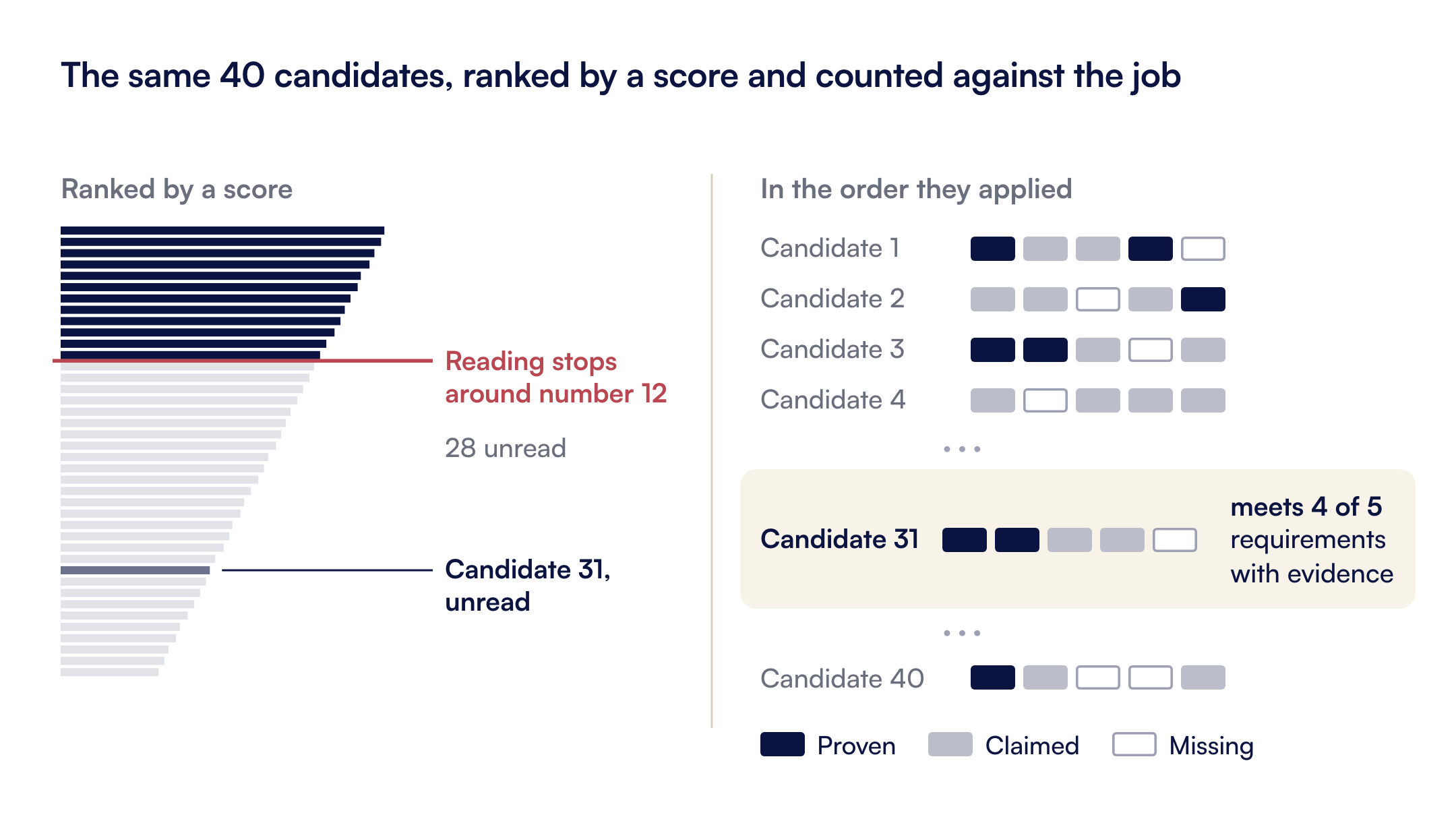
A count describes one candidate against the job: which requirements have evidence, and which do not.
A rank describes candidates against each other, and quietly tells the reader who to look at first. At volume, "who to look at first" easily becomes "who gets considered at all".
Our paper, The Radius Papers 01: A New Standard for Frontline Hiring, names this risk directly. Recommendations from a tool can become decisions in practice if nobody checks them. Designs that rank candidates or move them forward automatically put more weight on the tool's output. That makes human oversight, and the GDPR rules on automated decisions, more important to get right.
Under Article 22 of the GDPR, a decision about a candidate that has significant effects may not be based solely on automated processing, unless a narrow exception applies, such as necessity for entering into a contract. What the EU AI Act adds, and from when, is set out in our guide to the EU AI Act and recruitment.
Our view is simple. The person who is accountable for a hiring decision should also be the person who orders the shortlist, with the evidence in front of them. So we built the tool to show the evidence and leave the ordering to people.
Technology supports the evaluation of candidates. People make the hiring decision.
Isn't a count just a ranking by another name?
Not quite, but it can be read like one. Put "meets 5 of 5" next to "meets 2 of 5" and most readers will open the 5 first. The difference is what sits behind the number, and who sets the order. Behind the number, every requirement shows its own evidence, so the recruiter reads why, not just how many. Radius Hire does not sort the list by count. A count is still the tool's judgement. It is not the tool's ordering.
Application order has an effect too. If a recruiter still stops at number twelve, candidate 31 still goes unread, now because they applied later. No order is neutral. What changes is that application order makes no judgement about the candidate, and the choice of how far to read stays with a person who can see the evidence. If you cannot read every candidate, decide in advance how you will choose whom to read, and write that rule down.
What counting does not solve
We want to be as clear about the limits as about the principle.
Counting is still an automated assessment. Deciding that a requirement is "met with evidence" is a judgement, and the tool makes it. Counting moves less authority to the tool than ranking does. It does not move none.
An interview answer is still a claim until something tests it. A candidate who says they can start at 05:30 has given useful information. They have not proven it. The paper records evidence at five levels: verified, demonstrated, structured, claimed and not covered. Radius Hire's product shows three labels: Proven (broadly verified), Claimed and Missing (not covered).
The rating step stays with the recruiter. A structured interview asks every candidate the same job-related questions and rates each answer against a standard written in advance. In a design without scores, that rating happens with the recruiter. So employers still need to:
- write criteria for each requirement
- check that reviewers apply them the same way
- treat the count as evidence to review, not as a decision
And the most important limit: counting has not been shown to produce better hiring outcomes. Neither has ranking. The paper found no published evidence that either design leads to better hires. "Count, don't rank" is a design principle about where decision authority sits. It is not a proven performance advantage, and we do not present it as one.
Should AI rank job candidates?
We think not. A ranking orders people against each other, and at volume the order can decide who gets read at all. Radius Hire counts the requirements each candidate meets with evidence, lists candidates in the order they applied, and leaves the decision about who to read first to the recruiter.
Ranking can save time when the criteria are excellent and the oversight is real.
But in high-volume frontline hiring, the time pressure that makes ranking attractive is the same pressure that stops people from looking past the top of the list. We would rather give recruiters a clear view of the evidence for every candidate, and keep the ordering in human hands.
What should you ask an AI hiring tool about ranking?
Whether or not you use Radius Hire, start with these:
- What exactly does the system do with each answer: record, transcribe, summarise, score or rank?
- Is any candidate ever rejected or moved forward without a person reviewing their case?
- Can our reviewers see the evidence behind every output, and overrule it?
For the full list, including validity evidence, candidate information and data handling, see our guide to choosing AI recruitment software.
Closing thought
A shortlist is a decision, even when it does not look like one. We think that decision belongs to the person who will be accountable for the hire, with the evidence laid out in front of them.
See what "meets 4 of 5 requirements with evidence" looks like on screen. Book a demo.