The Radius Papers 03: What CVs Miss
A Practical Guide to Evidence-Based Frontline Hiring. For recruiters, branch managers and owners at Dutch staffing agencies, and for operations and HR managers who hire warehouse, logistics and production staff every week.
Check your inbox in the next few minutes.
Want to talk about your own numbers? Book a demo ›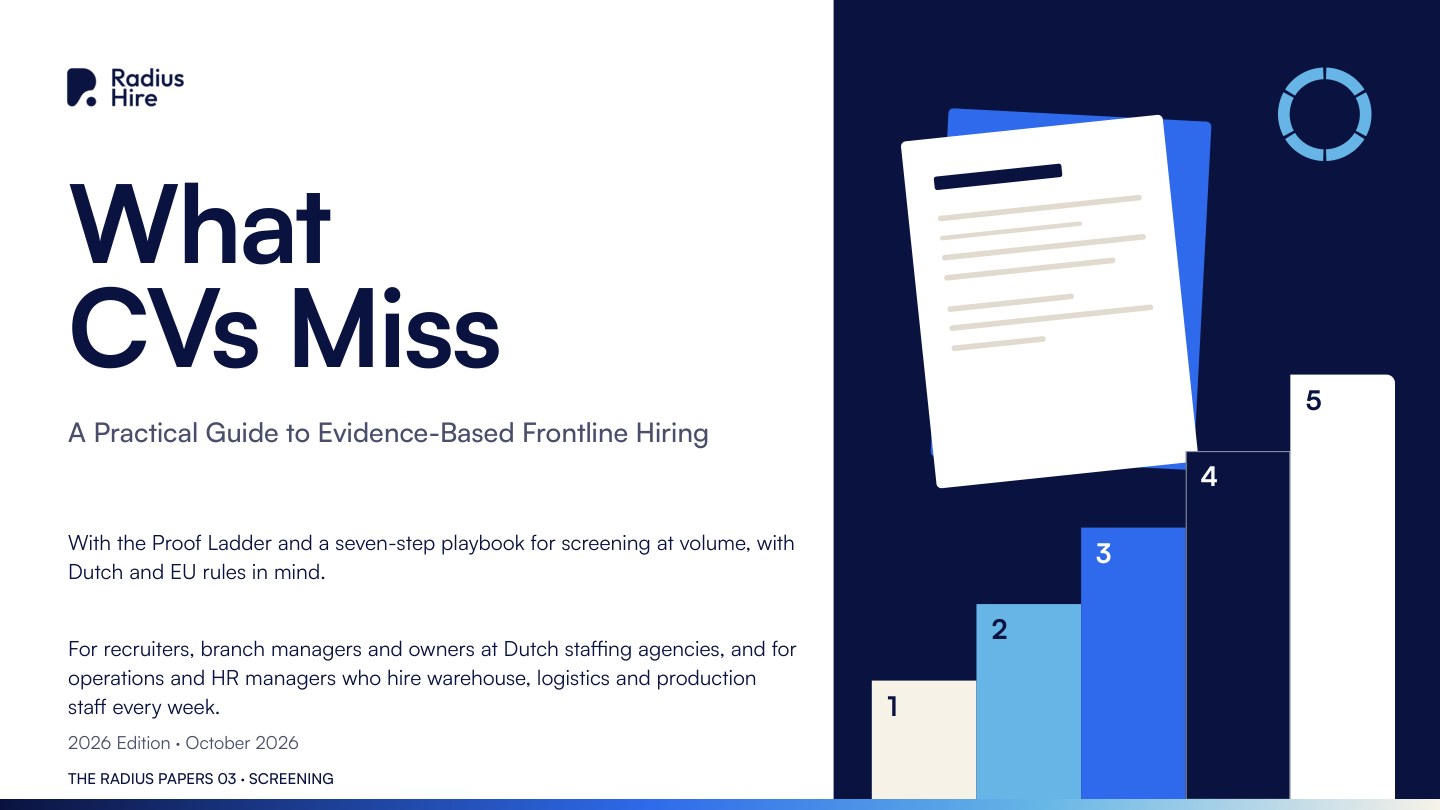
What the paper shows
Four of its charts, in its own numbers.
212 applications, 8.5 minutes each.
Monday, 08:10, a staffing branch in Venlo. A composite scene, not a documented case.
Five kinds of evidence. Five different questions.
- 1ClaimedWhat they say on their own terms. The CV.
- 2StatedSame question for everyone. Shift fit, commute.
- 3DemonstratedCan they show it? Job-knowledge question, short task.
- 4VerifiedIs this fact true? Certificate, licence, right to work.
- 5PerformedDid they do the job? Attendance, early leaving.
The Proof Ladder is a Radius Hire framework for designing and checking a screening process, not a scientifically tested scale.
Higher on the ladder doesn't mean better.
A verified certificate proves a fact, not a skill. Match each requirement to the rung that can answer it.
The short version
Monday, 08:10, a staffing branch in Venlo: 212 applications, three recruiters, about 8.5 minutes per application. What gets read is the CV. In the research, years of experience link with job performance at 0.07 and a structured interview at 0.42, where 0 is none and 1 is perfect (Sackett et al., 2022). These are averages across many studies, mostly outside the Netherlands. A composite scene, not a documented case.
What's inside
- The short version. One page, one action
- 212 applications, 8.5 minutes each. What gets read is the CV
- What a CV can and can't tell you. Useful, cheap, and not neutral
- When hiring goes wrong. Lessons from the real world
- Five kinds of evidence. Five different questions
- Structure predicts. Years don't
- The seven-step playbook. From job request to a decision you can explain
- Fair and lawful by design. What Dutch and EU rules mean for your screen
- What better evidence is worth. Two models, six numbers you already have
- Buyer's guide. Twelve questions to ask any screening supplier
- How Radius Hire does it. Structured evidence, the recruiter decides
- Proof is a design choice. What to do this week, this month and this quarter
Keep reading
Frequently asked questions
The Proof Ladder, in short.
The Proof Ladder is a Radius Hire framework that sorts screening evidence into five kinds: claimed (what the candidate says, such as the CV), stated (the same question for everyone), demonstrated (can they show it), verified (is this fact true) and performed (did they do the job). It is a design tool, not a scientifically tested scale.
No. A verified certificate proves a fact, not a skill. The paper’s advice is to match each requirement to the kind of evidence that can answer it, rather than verifying everything.
That a CV is useful, cheap and not neutral. In a composite scene from the paper, three recruiters face 212 applications at about 8.5 minutes each, and what gets read is the CV. In the research, years of experience relate to job performance at 0.07, against 0.42 for a structured interview (Sackett et al., 2022).
It takes you from the job request to a decision you can explain, with Dutch and EU rules in mind. The paper adds twelve questions to ask any screening supplier and two models to estimate what better evidence is worth, using six numbers you already have.
Recruiters, branch managers and owners at Dutch staffing agencies, and operations and HR managers who hire warehouse, logistics and production staff every week.