
Short answer: The Dutch Wtta is the law that requires labour providers, such as staffing agencies, to hold admission before they may supply workers. Hirers face two dates. From 1 January 2027 you must record which provider supplies each worker. From 1 January 2028 you may only use providers that are admitted, exempt or in the transitional arrangement.
If you are also looking at how hiring itself is organised across your sites, see how the Radius platform fits together.
Key takeaways
- Agencies that want the transitional arrangement sign up with the NAU (Nederlandse Autoriteit Uitleenmarkt) between 1 November and 31 December 2026. Hirers should ask each agency about it now.
- From 1 January 2027, a hirer must record which provider supplies each worker, no later than the day the placement starts, and keep that record for at least seven years.
- From 1 January 2028, a hirer may only use providers that are admitted, exempt or in the transitional arrangement.
- The Labour Authority can fine hirers under the new rules from 1 January 2028. Until then, the existing KVK rule and its fines apply.
- From 1 July 2027, the NAU's public register shows each provider's status.
On this page: What is the Wtta? · When does the Wtta take effect? · Which agencies can use the transitional arrangement? · What must a hirer record from 1 January 2027? · What must hirers do from 1 January 2028? · Which rule applies until the end of 2027? · Do hirers have to check the Wtta register? · What can hirers do now? · How Radius helps · FAQ
In October 2026, the procurement lead at a food producer in North Brabant gets an email from the operations director: "Which of our agencies will be admitted?"
Her list has agencies for order pickers and line workers, one for the Christmas peak, and a smaller one that brings in workers through a partner. The register that would answer her does not show agencies until July 2027.
This scene is a composite, not a documented case.
Her first deadline is earlier than she thinks. Her agencies have until 31 December 2026 to sign up for the transitional arrangement, and her own company has a record to keep from 1 January 2027.
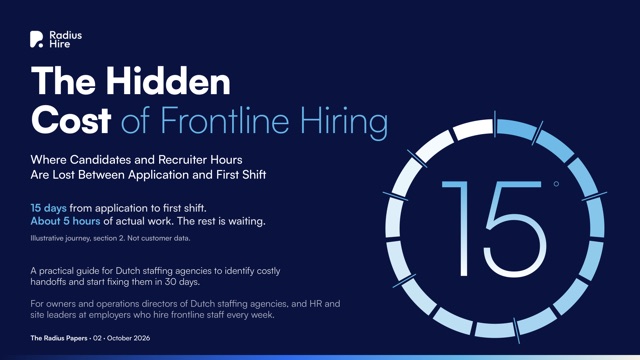
This article draws on Radius Hire's 2026 research paper on frontline hiring handoffs and on official Dutch sources. We say for each point whether it is law in force, enacted law with a future start date, an official schedule, guidance or a proposal. Good practice and our own reading are labelled.
What is the Wtta?
The Wtta is the Dutch law that brings in admission for labour providers. Its full name is the Wet toelating terbeschikkingstelling van arbeidskrachten (Staatsblad 2025, 385). Labour providers (uitleners) are companies that supply workers to other companies for a fee, such as staffing agencies, secondment firms and payroll companies.
The Wtta amends an existing law, the Waadi (Wet allocatie arbeidskrachten door intermediairs), where the hirer's duties sit. The Nederlandse Autoriteit Uitleenmarkt (NAU) runs the admission system and the public register; the Nederlandse Arbeidsinspectie (Netherlands Labour Authority) enforces. The hirer is called the inlener in Dutch.
When does the Wtta take effect?
On 1 January 2027, with the ban and fines from 1 January 2028. A royal decree (Staatsblad 2026, 159) brings the act into force in stages, and the NAU has set windows for providers. No date had changed when we checked on 20 October 2026.
| Date | What happens | Who must act | Type of rule |
|---|---|---|---|
| 1 November to 31 December 2026 | Providers sign up online for the transitional arrangement, using eHerkenning (a Dutch business login) at level 3 or higher and a Berichtenbox voor Bedrijven (the government's message box for businesses). | Existing providers. Hirers: ask your agencies. | NAU schedule, based on transitional rules in force since 1 July 2026 |
| 1 January 2027 | The Wtta takes effect. Providers must tell the hirer before each placement that the worker is supplied. Hirers must record the provider of each worker and cooperate with inspection bodies. | Hirers and providers | Enacted law, in force from this date |
| 1 May to 30 June 2027 | Providers apply for admission or an exemption. 30 June 2027 is also the legal deadline for the transitional arrangement. | Providers | NAU schedule; deadline set by law |
| From 1 July 2027 | The NAU starts assessing applications. The register shows whether a provider is admitted, exempt or in the transitional arrangement. | NAU; hirers | NAU schedule |
| 31 December 2027 | Last day of the rule that hirers may only use providers registered with the KVK (Chamber of Commerce) as labour providers. | Hirers | Law in force until this date |
| 1 January 2028 | Hirers may only use providers that are admitted, exempt or in the transitional arrangement, unless a legal exception applies. Enforcement and fines start. The KVK's Waadi registration and check end. | Hirers and providers | Enacted law, in force from this date |
Sources: Staatsblad 2026, 159; Waadi, Articles 7a, 12c, 12d, 12u, 16 and 23b; Nederlandse Autoriteit Uitleenmarkt; Rijksoverheid (8 October 2026). Dates checked on 20 October 2026.
Get Radius Signal. Radius Signal is a weekly email on frontline hiring in the Netherlands, sent every Thursday: Sign up for Radius Signal.
Which agencies can use the transitional arrangement?
Existing providers that apply by 30 June 2027. If a provider files its first application for admission, or for an exemption, within six calendar months after the Wtta takes effect, and the NAU has not decided by 1 January 2028, the ban on supplying workers without admission does not apply to it until the decision is published (Waadi, Article 23b(1), in force since 1 July 2026).
The NAU has made this two steps: sign up between 1 November and 31 December 2026, then apply between 1 May and 30 June 2027. Sign-up needs eHerkenning at level 3 or higher, a Berichtenbox voor Bedrijven, correct KVK details, the expected 2026 net turnover and the planned type of application. No certificate of good conduct (VOG) is needed.
Whether an agency must sign up depends on the SNA quality mark, the voluntary certificate of the Stichting Normering Arbeid. An agency that holds the mark on 30 June 2027 does not have to, although the NAU advises it. The NAU says an agency without the mark must sign up. The law lets it apply before it has an inspection report only if it told the minister before 1 January 2027 that it would apply (Article 23b(2)), and it must show it is working to get the report.
An agency that does not sign up in time cannot use the arrangement, the NAU adds, and must be admitted by 1 January 2028 to keep supplying workers. So an agency without the SNA mark that misses 31 December 2026 may have to stop supplying your workers on 1 January 2028.
What must a hirer record from 1 January 2027?
Which provider supplies each worker, by the day the placement starts. The hirer records in its own records which worker is supplied by which company, in line with the provider's notice, no later than the day the placement starts. It keeps the record for at least seven years after the end of the calendar year in which the placement ended (Waadi, Article 12d(2) and (3)). The provider must send that notice in writing or electronically before the placement starts (Article 12c(2)).
The NAU's page for hirers is stricter: record the provider before the work starts. The legal deadline is the end of the first day, so inspectors can check from the next day (explanatory memorandum). Good practice: make the record before the first shift, which meets both. If an agency does not send the notice, ask for it, because your record has to match it.
A company that lends a hired-in worker on to another company also counts as a hirer, and records the company that supplies the worker to it directly (Article 12d(4)). Also from 1 January 2027, a hirer must give an inspection body the information and help it needs to report on a provider's equal treatment of supplied workers (Article 12u).
Can a missing record be fined in 2027?
No, in our reading, but the duty still applies. In 2027 the record duty is not on the Waadi's list of fineable offences (Article 16). It joins that list, with the hiring ban and the cooperation duty, on 1 January 2028 (Staatsblad 2026, 159). Dutch administrative law only allows a fine for conduct that was already an offence when it happened (General Administrative Law Act, Article 5:4(2)), and the decree says 2027 is for information and support before formal enforcement.
A missed record in 2027 still breaches a legal duty, and 2027 records must be kept for seven years.
What about the information you give providers?
That duty already exists. A hirer must give its provider the terms of employment that apply to comparable staff, before the placement and when they change (Waadi, Article 12a(1), law in force). From 1 January 2027 the provider must pass this on to the worker (Article 12a(2)). This is not a fineable offence; the decree says such rules are enforced through the civil courts.
What must hirers do from 1 January 2028?
Use only providers that are allowed to supply workers. A hirer may not have work done by a worker supplied in breach of the provider ban (Waadi, Article 12d(1)). In practice you may use:
- providers with admission (toelating, valid four years) or provisional admission (voorlopige toelating, a one-off six months for new providers);
- providers with an exemption (ontheffing);
- providers in the transitional arrangement whose application the NAU has not yet decided;
- organisations the law keeps outside the admission system (see below).
In a chain, check both the company that employs the worker and the one that supplies the worker to you (Article 12d(1)).
Can we keep using an agency in the transitional arrangement?
Yes. The law switches off the provider ban for these agencies until the decision is published (Article 23b(1)), and the hiring ban only covers workers supplied in breach of that ban. The explanatory memorandum says it directly: hirers may hire from such a provider without breaching the Waadi. The register shows them with a separate status (Staatsblad 2026, 41, Article 1b:11).
If the NAU refuses an application, or suspends or withdraws an admission or exemption, the decision takes effect no later than four weeks after it is published. Until then the agency may only keep supplying workers already placed with you, and you may not take on new ones from it (Articles 12h and 12n).
Can a hirer be fined, and how much?
Yes, from 1 January 2028. The NAU says a hirer that works with a provider that needs admission but lacks it can be fined by the Labour Authority and must stop the cooperation. From that date, breaching the hiring ban, missing the record, refusing to cooperate with an inspection body and taking on new workers during the four weeks after a negative decision are all fineable (Article 16).
The law sets the framework, not the amount:
- Maximum: the fifth fine category of the Dutch Criminal Code (Waadi, Article 19(1)), which is €110,000 since 1 January 2026 (Staatsblad 2025, 401) and is updated every two years.
- Per worker: the explanatory memorandum says the ban and the record duty are assessed for each worker supplied.
- Repeat offences: a repeat within five years raises the fine by 100 percent, or 200 percent in the cases the law sets out (Article 19).
The amounts go in a fining policy set by the minister. On 20 October 2026, the published Waadi fining policy only had amounts for the KVK rule, so we give no amount for 2028. Check for a new fining policy before 1 January 2028.
Which providers and arrangements fall outside the Wtta?
A few, and they are narrow. The law excludes three groups (Waadi, Article 1b):
- public bodies, to the extent that they employ people with an occupational disability, for example under the Sheltered Employment Act (Wsw) or the Participation Act;
- foundations that employ students on the work-based vocational route (BBL) and place them with a recognised training company;
- licensed security companies and private investigation agencies.
Some arrangements are not supply of workers at all, such as lending within a group or lending your own staff at no more than wage cost (Article 1(3)). This depends on the facts.
An exemption is a provider's status, not a hirer's exception. It is for a company that has paid wages for at least twelve months and earns under 10% of its turnover, and at most €5,000,000 per twelve months, from supplying workers. A company that employs workers on temporary agency contracts cannot get one (Article 12e).
Which rule applies until the end of 2027?
The existing KVK rule, which is law in force. Until 31 December 2027, a hirer may not use workers from a provider that is not registered in the KVK trade register as supplying workers (Waadi, Article 7a). The article lapses on 1 January 2028, but a breach before then can still be fined (Article 23a).
For a hirer, the fining policy sets a base fine of €8,000 for fewer than 10 workers, €16,000 for 10 to 29 and €32,000 for 30 or more. It can rise by 50%, for example after an earlier Waadi offence in the past five years, or be halved where the hirer was less to blame.
From 1 January 2028 the KVK's Waadi register moves to the NAU register and the KVK's check for hirers ends. Providers must still be registered with the KVK (Nederlandse Autoriteit Uitleenmarkt).
Do hirers have to check the Wtta register?
The law bans using a provider without admission; checking is the NAU's advice. From 1 July 2027, the register shows whether a provider is admitted, exempt or in the transitional arrangement, and whether a negative decision is about to take effect.
Radius Hire's research paper suggests one register check per provider. The Wtta register is about providers, so the check belongs at provider level, not with every worker. Repeat it on a fixed schedule, as the NAU advises.
A check like this needs, in the paper's words, one named owner, a deadline and a record of who checked what and when. Our suggestion: that owner can sit in procurement rather than on the shop floor.
What can hirers do now?
Start with a list of your providers and one owner. These are good-practice steps, not legal requirements.
- List every provider you hire workers from. For chains, note both the worker's employer and the company that supplies the worker to you.
- Before 31 December 2026, ask each agency: does it hold an SNA quality mark, will it sign up for the transitional arrangement, and does it have eHerkenning at level 3 or higher?
- Set up the provider record before 1 January 2027. For each placement: worker, provider and start date, made before the first shift. Keep it for at least seven years.
- Keep checking KVK registration until 31 December 2027.
- Confirm each agency applied between 1 May and 30 June 2027.
- From 1 July 2027, check each provider in the register, note the date and status, and repeat on a fixed schedule.
- Before 1 January 2028, decide on any provider that is not admitted, exempt or in the transitional arrangement.
- Name one owner for the register check and the provider record.
None of these needs new software: a shared list with an owner, a date and the register result is enough. Where the facts are unclear, take legal advice.
How Radius helps
Radius Hire is an AI hiring platform for frontline roles, built in Amsterdam for staffing agencies and employers who hire for the work floor. It is built to source, interview and verify applicants, while a person makes every hiring decision. The Radius ATS is built to run one pipeline from applied to signed, per role, site and client, and it can run alongside an existing ATS. Messages, notes, the interview, offers and contracts sit on one candidate record. The Wtta provider record, the register check and the choice of agencies stay with your own named owner.
FAQ
Where can I check whether an agency is admitted under the Wtta?
In the NAU's public register, from 1 July 2027. It shows whether a provider is admitted, exempt or in the transitional arrangement; the NAU advises checking it regularly. Until 31 December 2027, also check each provider's KVK registration as a labour provider.
Does the Wtta replace the checks on each agency worker?
No. The Wtta checks the provider, not the person. The hirer's own checks on each agency worker before the first shift stay in place, such as the identity check that Dutch government guidance describes. Keep them as a separate step with its own owner. Hiring agency workers: Dutch chain liability, checks and Wav fines covers those checks.
Does the Wtta apply when a worker is lent on through another company?
Yes. A company that lends a hired-in worker on counts as a hirer, so it keeps its own record and may only use providers that are allowed to supply workers (Waadi, Article 12d(4)). The company where the work is done must check both the worker's employer and the company that supplies the worker directly.
Could the Wtta rules still change before 2028?
Yes, details can still change. The law website marks the 2027 and 2028 Waadi text as future text. From 8 to 22 October 2026 the government consulted on adding equal pay to the admission criteria from 1 July 2027; that is a proposal, not law. No fine amounts for the new offences had been published by 20 October 2026.
What is eHerkenning, and why does it matter to hirers?
eHerkenning is a Dutch login that businesses use for government services. Agencies need it at level 3 or higher to sign up for the transitional arrangement between 1 November and 31 December 2026. A hirer does not sign up itself, but an agency without the login cannot sign up, so ask early.
Sources
- Radius Hire (2026). The Radius Papers 02: The Hidden Cost of Frontline Hiring. White paper. https://radiushire.com/white-papers/radius-papers-02.
- Kingdom of the Netherlands (2025). Wet van 12 november 2025 (Wet toelating terbeschikkingstelling van arbeidskrachten), Staatsblad 2025, 385. Act. https://zoek.officielebekendmakingen.nl/stb-2025-385.html, accessed 20 October 2026.
- Kingdom of the Netherlands (2026). Besluit van 24 juni 2026 tot vaststelling van het tijdstip van inwerkingtreding van de Wet toelating terbeschikkingstelling van arbeidskrachten, Staatsblad 2026, 159. Entry-into-force decree with explanatory note. https://zoek.officielebekendmakingen.nl/stb-2026-159.html, accessed 20 October 2026.
- Kingdom of the Netherlands (2026). Besluit van 16 februari 2026 tot wijziging van het Besluit allocatie arbeidskrachten door intermediairs, Staatsblad 2026, 41. Decree with explanatory note. https://zoek.officielebekendmakingen.nl/stb-2026-41.html, accessed 20 October 2026.
- Tweede Kamer (2023). Wet toelating terbeschikkingstelling van arbeidskrachten: Memorie van toelichting, Kamerstukken II 2023/24, 36 446, nr. 3. Explanatory memorandum. https://zoek.officielebekendmakingen.nl/kst-36446-3.html, accessed 20 October 2026.
- Government of the Netherlands. Wet allocatie arbeidskrachten door intermediairs (BWBR0009616), version in force from 1 July 2026 (Articles 7a, 12a, 23b). Statute. https://wetten.overheid.nl/BWBR0009616/2026-07-01, accessed 20 October 2026.
- Government of the Netherlands. Wet allocatie arbeidskrachten door intermediairs (BWBR0009616), version from 1 January 2027, future text (Articles 1b, 12a, 12c to 12e, 12u, 16). Statute. https://wetten.overheid.nl/BWBR0009616/2027-01-01, accessed 20 October 2026.
- Government of the Netherlands. Wet allocatie arbeidskrachten door intermediairs (BWBR0009616), version from 1 January 2028, future text (Articles 1, 12d, 12h, 12n, 16, 19, 23a, 23b). Statute. https://wetten.overheid.nl/BWBR0009616/2028-01-01, accessed 20 October 2026.
- Minister of Social Affairs and Employment. Beleidsregel boeteoplegging Wet allocatie arbeidskrachten door intermediairs 2014 (BWBR0034835), version in force from 2 April 2026. Fining policy. https://wetten.overheid.nl/BWBR0034835/2026-04-02, accessed 20 October 2026.
- Kingdom of the Netherlands (2025). Besluit van 26 november 2025 tot wijziging van de bedragen van de categorieën, bedoeld in artikel 23, vierde lid, van het Wetboek van Strafrecht 2026, Staatsblad 2025, 401. Decree. https://zoek.officielebekendmakingen.nl/stb-2025-401.html, accessed 20 October 2026.
- Government of the Netherlands. Algemene wet bestuursrecht (BWBR0005537), Article 5:4. Statute. https://wetten.overheid.nl/BWBR0005537/2026-07-01, accessed 20 October 2026.
- Nederlandse Autoriteit Uitleenmarkt (n.d.). Home page (important dates). Official guidance. https://www.toelatinguitleenmarkt.nl/, accessed 20 October 2026.
- Nederlandse Autoriteit Uitleenmarkt (n.d.). Inleners. Official guidance. https://www.toelatinguitleenmarkt.nl/inleners, accessed 20 October 2026.
- Nederlandse Autoriteit Uitleenmarkt (n.d.). Aanmelden voor de overgangsregeling. Official guidance. https://www.toelatinguitleenmarkt.nl/uitleners/welke-soorten-aanvraag-zijn-er/aanmelden-voor-de-overgangsregeling, accessed 20 October 2026.
- Rijksoverheid (2026, 8 October). Internetconsultatie: wijziging eisen wanneer bedrijven personeel mogen uitlenen. Government news. https://www.rijksoverheid.nl/actueel/nieuws/2026/10/08/internetconsultatie-wijziging-eisen-wanneer-bedrijven-personeel-mogen-uitlenen, accessed 20 October 2026.
This article is general information, not legal advice. Legal points were checked against official sources on 20 October 2026.